Yoga for beginners: 10 simple asanas for home practice without a trainer
Why yoga for beginners is not about flexibility, but about connecting with yourself
When we hear the phrase "yoga for beginners," images from social media often come to mind: people in unimaginable poses, with perfect posture and a detached gaze. Because of this, it seems that yoga is the domain of the chosen few — those whose bodies are naturally flexible and whose minds are calm. In reality, yoga is not gymnastics and not a competition with yourself. It is, first and foremost, a way to hear your body and come to an agreement with your own mind. And you can start this dialogue right now, at home, without a trainer or special preparation.
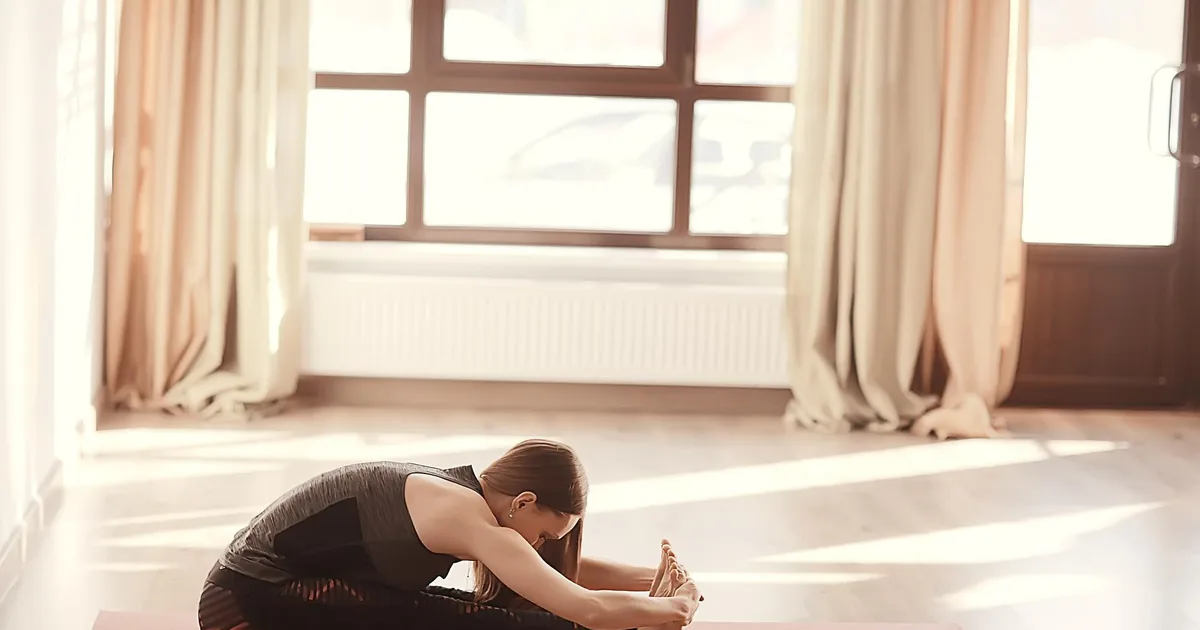
From the perspective of energy practices, asanas are not just physical exercises. They are tools for redistributing energy in the body. Each pose creates a certain configuration of flows, helping to release blocks and tensions that have been accumulating for years. When we perform asanas slowly and mindfully, we are not just stretching muscles — we are learning to be present in the moment, to listen to the body's signals, and to quiet the inner dialogue. This is exactly the mindfulness practice that is so often discussed in esoteric traditions.
Many people are afraid to start because of the fear of "not being able to do it" or "it will hurt." But yoga for beginners at home is a safe and gentle process if approached wisely. You don't have to touch the floor or twist yourself into a knot. Your task is to feel how the body responds to movement, how breathing feels in each pose, and where exactly tension is hiding. This is meditation in motion, accessible to everyone.
First steps: how to prepare your space and tune into practice
Before we move on to specific asanas, let's talk about what you need for a comfortable home practice. You won't need an expensive mat or special clothing from well-known brands. Comfortable clothing that doesn't restrict movement and a small space where you can freely stretch out to the sides are enough. Ideally, this should be a quiet room where no one will disturb you for 15–30 minutes. If possible, air out the room — fresh air helps with mental clarity.
An important point is intention. Before starting your practice, take a minute to formulate why you are stepping onto the mat today. It could be a desire to release tension after a workday, to charge yourself with energy in the morning, or simply to spend time with yourself. Intention is a kind of anchor that holds your attention and turns physical exercises into a spiritual practice. You don't need to come up with complex formulations — a simple and honest "I'm doing this to feel better" is enough.
If you are looking for video yoga for beginners at home, pay attention to lessons where the instructor explains in detail the position of each part of the body and offers simplified variations of asanas. A good video is like a personal trainer who is always by your side. But even if you practice without a video, our selection of 10 asanas will be your reliable support. Remember: the main thing is not speed or complexity, but regularity. It's better to practice for 15 minutes every day than for an hour once a month.
10 simple asanas for home practice: from warm-up to deep relaxation
This sequence is designed to gently warm up the body, work through the main muscle groups, and finish the practice with relaxation. Hold each asana for 3 to 5 breathing cycles (inhale-exhale) unless otherwise stated. Breathe evenly and calmly through the nose. If any pose causes sharp pain — exit it gently and rest in child's pose. Pain is a signal that cannot be ignored.
1. Mountain pose (Tadasana)
Stand straight, feet together or hip-width apart. Distribute your weight evenly across the entire foot. Engage your knees, tighten your glutes, but do not squeeze your lower back. Arms hang freely along the body, palms facing forward. Reach up through the crown of your head, as if you are suspended by a string. This asana teaches proper body alignment and helps you feel grounded. It is the foundation for all other poses.
2. Chair pose (Utkatasana)
From Tadasana, on an inhale raise your arms up, and on an exhale bend your knees as if sitting on an invisible chair. Thighs should be parallel to the floor or slightly higher. Make sure your knees do not extend past your toes. Do not arch your lower back; tuck your tailbone down. Utkatasana excellently strengthens the muscles of the legs and back, and also stokes the inner fire, giving energy for the entire practice.
3. Downward-facing dog pose (Adho Mukha Svanasana)
Come onto all fours, hands under shoulders, knees under hips. On an exhale, lift your hips up, straightening your legs and arms. The body should resemble an inverted letter "V." Reach your heels toward the floor, but you don't have to place them down. Keep your back straight, neck relaxed, gaze directed toward your feet. This is one of the key asanas in yoga for beginners, as it stretches the back of the thighs, strengthens the arms and shoulders, and calms the mind.
4. Warrior I pose (Virabhadrasana I)
From downward-facing dog, step your right foot forward between your hands. Turn your left foot out 45 degrees. On an inhale, lift your torso and arms up, bringing palms together overhead. Bend your right knee to a right angle; your left leg is straight and engaged. Hips face forward. This pose develops strength and endurance, and also symbolizes the inner warrior who faces challenges with dignity.
5. Triangle pose (Trikonasana)
Stand with your feet wide apart (about a meter). Turn your right foot out 90 degrees, and your left foot slightly inward. Extend your arms out to the sides at shoulder height. On an exhale, reach your torso to the right, lowering your right hand to your shin, ankle, or the floor (wherever you can reach). Your left arm points up, gaze toward your left palm. Trikonasana opens the chest, improves digestion, and helps release tension from the lower back.
6. Cat-cow pose (Marjaryasana-Bitilasana)
Come onto all fours, hands under shoulders, knees under hips. On an inhale, arch your back down, lifting your head and tailbone up — this is cow pose. On an exhale, round your back, tuck your chin to your chest, and tuck your tailbone down — this is cat pose. Move smoothly, in rhythm with your breath. This cycle is an excellent warm-up for the spine; it releases tension from the back and neck, improves flexibility, and calms the nervous system.
7. Child's pose (Balasana)
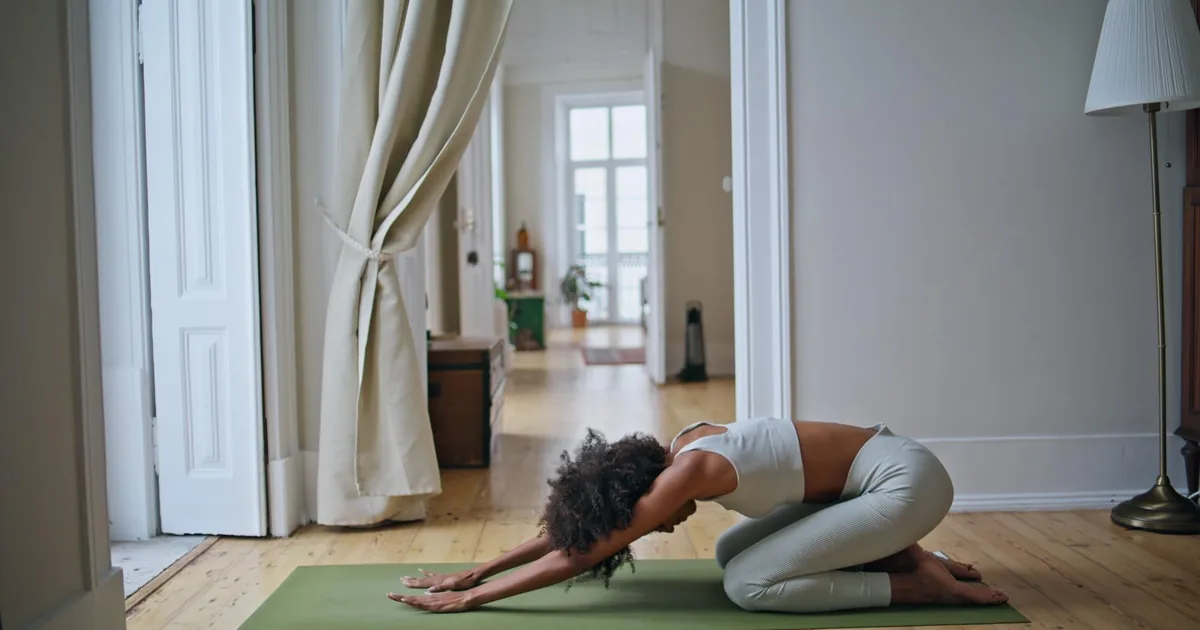
Sit on your heels, knees together or slightly wider. On an exhale, fold your torso forward, lowering your belly onto your thighs. Place your forehead on the floor or on stacked hands. Extend your arms forward or along your body. This is a pose of deep rest and recovery. You can stay here as long as needed, especially if you feel tired or dizzy. Balasana helps calm the mind and relieve stress.
8. Pigeon pose (Eka Pada Rajakapotasana — simplified variation)
From child's pose, lift your torso, extend your right leg back, and bend your left leg in front of you so that your left foot is under your right hip. Your right leg is extended back, hips facing forward. If your hip doesn't lower to the floor, place a cushion or blanket under your glute. Fold your torso forward, resting on your forearms. This is a deep opening of the hip joints, where emotional blocks often hide. Hold the pose for 5-7 breaths, then switch sides.
9. Reclining twist pose (Supta Matsyendrasana)
Lie on your back, knees bent, feet on the floor. Extend your arms out to the sides at shoulder height. On an exhale, lower both knees to the right, trying to keep your shoulder blades on the floor. Turn your head to the left. Feel a gentle twist in the lower back and thoracic spine. This pose massages the internal organs, improves digestion, and releases tension from the spine. Switch sides.
10. Corpse pose (Savasana)
Lie on your back, legs extended, arms resting freely along the body with palms facing up. Close your eyes. Completely relax all the muscles of your face, jaw, and tongue. Allow your body to become heavy and your thoughts to dissolve. Stay in Savasana for 5 to 10 minutes. This is the most important asana, which integrates the effects of the entire practice. Don't skip it, even if you're in a hurry. It is in this complete relaxation that you absorb the energy you have cultivated during your practice.
Table: common beginner mistakes and how to avoid them
| Mistake | Why it hinders practice | How to fix it |
|---|---|---|
| Comparing yourself to others or to pictures on the internet | Causes feelings of inadequacy and tension in the body | Focus on your own sensations. Your practice is only yours |
| Holding your breath | Creates tension and deprives movement of energy | Breathe evenly and calmly. If your breath becomes erratic — simplify the pose |
| Rushing and mechanical execution | Turns yoga into physical exercise and has no effect on the mind | Slow down. Hold each pose for at least 3 breaths |
| Ignoring pain | Can lead to injury | Sharp pain is a signal to stop. Mild stretching is normal |
Morning yoga for beginners: how to charge your day with energy
Morning yoga for beginners deserves special attention. Practicing at dawn has a special energy: the world is still asleep, and you can be alone with yourself. Morning asanas help "switch on" the body after sleep, get the blood flowing, and tune in for an active day. Even 15 minutes of morning practice can transform your state beyond recognition: you will feel more energetic, calmer, and more focused.
The following asanas from our list are ideal for morning practice: Tadasana, Utkatasana, Marjaryasana-Bitilasana, Adho Mukha Svanasana, and Virabhadrasana I. They are dynamic enough to wake up the body, but not too intense to overload it. Finish your morning practice with a short Savasana — just 3-5 minutes. This is enough time to absorb the energy and transition from a state of rest to a state of activity.
If you are looking for morning yoga for beginners 15 minutes, you can simply perform this sequence at a calm pace, giving each asana 5 breaths. This is quite enough for a full awakening. The main thing is to do it regularly. Within a week, you will notice that waking up has become easier and your mood has improved.
Yoga for beginners for weight loss: myths and reality
Many people come to yoga with the goal of losing weight. And that's wonderful, but it's important to understand that yoga for beginners for weight loss works differently than intense cardio workouts. Yoga doesn't burn thousands of calories per session, but it changes your relationship with your body and food. You begin to feel your body better — its signals of hunger and satiety. This helps you avoid overeating and choose healthier food.
Additionally, regular asana practice speeds up metabolism, improves digestion, and normalizes hormonal balance. Twisting poses (like Supta Matsyendrasana) massage the internal organs, while strengthening poses (like Utkatasana and Virabhadrasana) build muscle and create a beautiful physique. But the main secret is that yoga lowers cortisol levels — the stress hormone that contributes to fat accumulation in the abdominal area. When you are calm, the body more easily lets go of excess weight.
If your goal is weight loss, practice yoga at least 3 times a week for 30 minutes. Combine dynamic poses (warriors, downward-facing dog) with relaxing ones (child's pose, twists). And be sure to dedicate time to Savasana — it is in a state of rest that the body shifts into fat-burning mode.
Table: how to choose a practice format for your needs
| Your need | What to practice | Duration | Focus |
|---|---|---|---|
| Relieve stress and calm down | Balasana, twists, Savasana | 20-30 minutes | Breathing and relaxation |
| Charge with energy in the morning | Tadasana, Utkatasana, Virabhadrasana | 15-20 minutes | Strength and vitality |
| Lose weight and tone the body | All 10 asanas in a dynamic flow | 30-45 minutes | Intensity and regularity |
| Improve flexibility | Trikonasana, pigeon, downward-facing dog | 20-30 minutes | Stretching and opening |
How to breathe correctly during asanas
Breath is the bridge between the body and the mind. In yoga, there is a special term "pranayama" — the control of life energy through breath. Beginners don't need to master complex breathing techniques. It's enough to learn one simple rule: upward movement and opening — on the inhale; downward movement and twisting — on the exhale. For example, in Utkatasana you raise your arms on the inhale and bend your knees on the exhale.
Breathing should be even and calm, through the nose. If you notice that you are holding your breath or it becomes choppy — this is a signal that you've taken on too difficult a pace or overexerted yourself. Simplify the pose or rest in Balasana. Remember: your breath is your main guide. If you are breathing evenly, you are in a safe and beneficial state.
Mindful breathing during practice is meditation itself. You are focused on the flow of air, on the movement of the diaphragm, on the sensations in the body. Thoughts fade into the background. This is a natural way to calm the mind and enter a state of presence. Over time, you will notice that this state of calm and clarity carries over into everyday life.
Mindfulness practice: how to connect yoga with other esoteric tools
Yoga is not an isolated practice. It combines beautifully with other tools of self-discovery that we discuss on the EXETERIC blog. For example, understanding your human design guide can help you choose the time and type of practice that best resonates with your energy. If you are a Generator, dynamic and responsive practices suit you; if you are a Projector — more contemplative and restorative ones.
Astrology can also offer clues. For instance, in the astrology section, you can learn which lunar days are best for starting new practices and which are better for cleansing. This is not fatalism, but rather a way to live in harmony with natural rhythms. If the Moon is in Taurus — a great time for bodywork; in Gemini — for breathing practices.
Yoga is a physical practice, but its results extend far beyond the physical body. It cleanses the energy channels (nadis), balances the chakras, and enhances your intuition. You begin to hear yourself and your true desires more clearly. This is the path to self-discovery that we discuss in articles on magic and self-discovery. Yoga is not an escape from reality, but a way to meet it face to face, armed with calmness and clarity.
Table: myths about yoga that prevent you from starting
| Myth | Why it's not true | How it really is |
|---|---|---|
| Yoga requires flexibility | Flexibility is a result, not a prerequisite | Practice gradually makes the body more flexible |
| Yoga is a religion | It's a spiritual practice, but not a religion | You can be anyone and practice yoga |
| You need a trainer | For basic asanas, videos and instructions are enough | Home practice is safe when following the rules |
| Yoga is boring | It's a deep exploration of yourself | Every practice is unique and full of discoveries |
How to make practice regular: motivation tips
The hardest part of yoga for beginners is not mastering the asanas, but making practice regular. We often quit after a week because we don't see quick results. But yoga is a practice of cumulative effect. Changes happen subtly, but they are deep and lasting. To avoid quitting, follow a few simple rules.
First, choose a time that works for you. It could be morning, afternoon, or evening. The key is that this time is consistent. Second, start small — with 15 minutes. Yoga for beginners 15 minutes a day is a realistic goal that is easy to achieve. Gradually, you will want to increase your practice time. Third, find inspiration. Watch yoga for beginners video lessons, read articles about yoga and esoterics, connect with like-minded people.
And remember: missing one day is not a catastrophe. What matters is returning to the mat the next day. Don't scold yourself for imperfection. Yoga is a journey, not a destination. Every time you step onto the mat, you take a step toward yourself. And that step always matters, no matter how small.
Safety guidelines: how to avoid injuries and get maximum benefit
Safety is the foundation of any practice, especially when practicing at home without a trainer. Yoga for beginners at home requires special attention to the body's signals. Here are a few important rules that will help you avoid injuries and make your practice as beneficial as possible. First, always start with a warm-up. Even 5 minutes of simple movements (head tilts, shoulder rolls, cat-cow) will prepare your joints and muscles for the load.
Second, don't neglect simplified variations of asanas. If you can't reach the floor in Trikonasana — lower your hand to your shin or a block. If your knees hurt in pigeon pose — place a cushion under your glute. Using props is not a sign of weakness, but a sign of wisdom. Third, avoid sudden movements and jerks. Enter poses smoothly, with an exhale, and exit them just as smoothly.
Pay special attention to your knees and lower back. If you have chronic conditions, consult a doctor before starting practice. And never tolerate sharp pain. Sharp pain is a signal that you are doing something wrong. Exit the pose, rest, and try a simplified version or skip that asana today. Your body will tell you what it needs.
Practice for deep relaxation: evening sequence
Evening practice differs from morning practice. It is aimed not at vitality, but at relaxation and preparing for sleep. If you've had a stressful day, yoga for beginners 30 minutes in the evening will help relieve fatigue and calm the mind. For evening practice, choose slow and restorative asanas: Balasana, Supta Matsyendrasana, gentle forward folds, and, of course, a longer Savasana.
In evening practice, you can devote more time to breathing. Try lengthening your exhale: inhale for 4 counts, exhale for 6. This activates the parasympathetic nervous system, which is responsible for relaxation. You will notice how the body becomes heavier and thoughts slower. This is the ideal state for falling asleep.
Perform the evening sequence in dim light; you can light a candle or an aroma lamp with lavender. This will create an atmosphere of coziness and peace. After practice, don't get up abruptly. Lie in Savasana for a few minutes, then slowly roll onto your right side, sit for a moment, and only then get up. This way you preserve the state of peace and smoothly return to activity.
Yoga as a path to yourself: a practice that stays with you
When we talk about yoga in the context of esoterics, it's important to understand: it's not a magic pill or a way to escape reality. It's a tool that helps us become more conscious, calm, and whole. Asanas are just the outer shell, behind which lies a deep inner process. By performing simple poses, you learn not only to control your body, but also to observe your thoughts, emotions, and reactions. This is the very practice of self-discovery that changes life from within, requiring nothing from you except regularity and honesty with yourself.
Perhaps you came to yoga for flexibility, weight loss, or stress relief. But over time, you will notice that the effect is much deeper. You begin to breathe differently, feel differently, react to challenges differently. This happens subtly, but these changes are the real magic. Don't be afraid of what seems unclear or mystical. Esoterics is not about fear or blind faith, but about careful and respectful exploration of yourself and the world. Start small — with these ten asanas, with 15 minutes of silence on the mat, with one conscious breath.
If you want to deepen your understanding and find other tools for harmonizing your life, check out the articles on magic and self-discovery section. There you will find materials that help connect physical practice with work on energy, thoughts, and intentions. And if you're curious how your energy and character influence your choice of practice, check out the astrology section — perhaps your zodiac sign will suggest which poses and practice schedule suit you best. Studying yourself through different systems is a fascinating journey in which yoga will become a reliable compass.
At EXETERIC, we believe that every person is capable of finding their own path to harmony. You don't have to become a hermit or meditate for hours in the mountains. It's enough to dedicate a little time each day to yourself, your body, and your breath. Practice mindfully, without violence toward yourself, with respect for your capabilities. And remember: EXETERIC practices are not a dogma, but an invitation to a dialogue with yourself. Start today, and within a few weeks you will feel the world around you becoming a little clearer, and a quiet confidence arising within. You are on the right path.
Frequently asked questions
How many times a week should a beginner practice yoga to see results?
For beginners, it's optimal to practice 3-4 times a week for 20-30 minutes. However, the key factor is not quantity but regularity. It's better to practice for 15 minutes every day than for two hours once a month. Regular practice helps the body remember new movement patterns and the mind to calm down. If you feel tired, you can make the practice shorter, but don't skip it entirely. After 2-3 weeks, you will notice that your body has become more flexible and your sleep deeper.
What should I do if I experience back or knee pain during asanas?
Pain is a signal that cannot be ignored. If you feel sharp or acute pain, immediately exit the pose and rest in child's pose. Mild stretching in the muscles is normal, but pain in the joints or spine is not. Check whether the pose is aligned correctly: perhaps you are overstraining your lower back or knees. Use props — cushions, blankets, or blocks — to reduce the load. If the pain persists after practice, consult a doctor.
Can I lose weight by practicing yoga at home, or do I need more intense workouts?
Yoga can help with weight loss, but it works differently than cardio workouts. It speeds up metabolism, normalizes hormonal balance, and lowers cortisol levels — the stress hormone that contributes to fat accumulation. Additionally, yoga changes your relationship with your body and food, helping you avoid overeating. For noticeable results, practice at least 3 times a week for 30-40 minutes, combining dynamic poses (warriors, downward-facing dog) with relaxing ones. Remember that sustainable results come gradually, but they are deeper than those from quick diets.
Do I need to understand esoterics and chakras to practice yoga?
No, you don't need deep esoteric knowledge to start practicing. A desire to listen to your body and breathe evenly is enough. However, understanding energy principles can deepen your practice. For example, knowing that twists help massage the internal organs, and that pigeon pose opens the hip joints where emotions often hide, will add mindfulness. You can start with the purely physical aspect, and over time, if you wish, study the connection between asanas and chakras and energy. The main thing is not to overload yourself with information at the start and to move at your own pace.