Chakras: A Map of 7 Centers in Simple Words
What Are Chakras and Why It's Not About "Magic from Movies"
The word "chakras" comes from Sanskrit and literally means "wheel" or "disk." In the Indian spiritual tradition, this term was used for energy centers located along the spine. Today, chakras are a convenient map for describing how energy circulates in the body and psyche: where we are "charged" and where we are leaking. These are not organs visible on an MRI, nor magical batteries. Rather, they are a metaphor that helps notice internal processes and regain your footing.
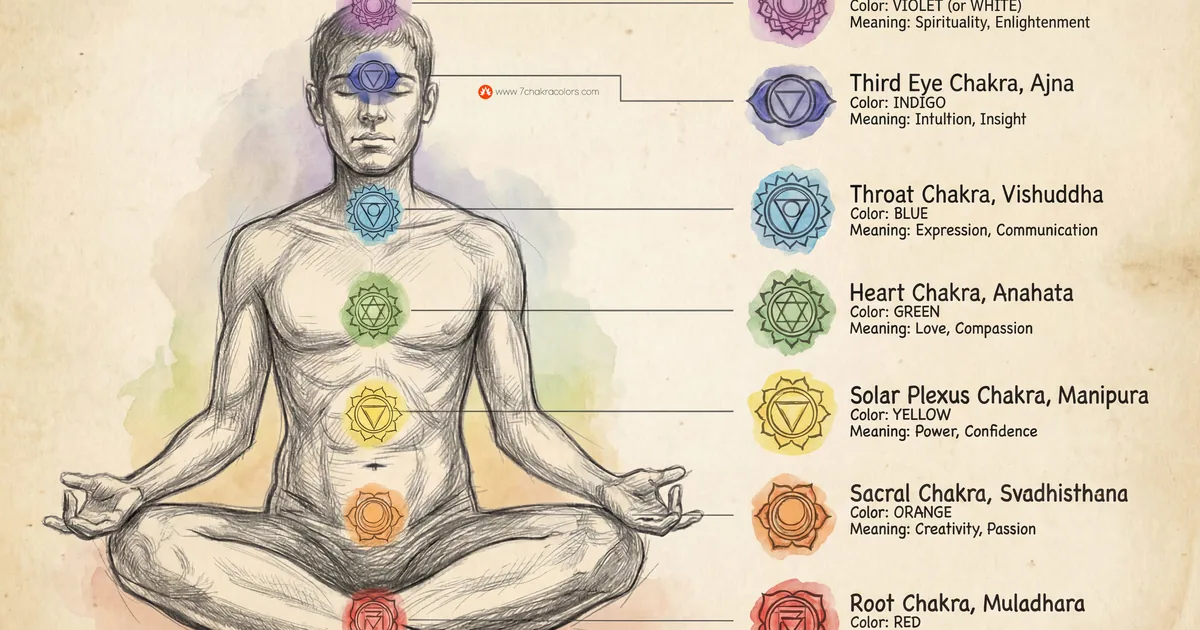
If you are just starting out, think of human chakras as seven levels of experience: from basic safety to connection with meaning. Each center has its own theme, its own color, its own area of responsibility. And each has its own signs of imbalance, which are easy to recognize in everyday life.
Here's a simple example. You wake up exhausted, even though you slept for eight hours. Coffee doesn't help, irritability builds up, and by evening you just want to lie down. According to the chakra map, this could indicate depletion of the first and second chakras — the zones of survival and pleasure. Not a "curse," not an "evil eye," but a signal: basic resources are at zero. And this can be worked with.
At EXETERIC, we adhere to a simple principle: esotericism is a tool for self-knowledge, not a reason for fear. Therefore, further on — no scare tactics, with respect for tradition and common sense. If you want to delve into related topics, check out other practices on the EXETERIC blog.
Chakra Locations: Where to Find Your Centers
The classic scheme is seven main centers running from the base of the spine to the crown. Where chakras are located is known even to those far from esotericism: it's a projection of the spinal column and adjacent areas. But it's important to understand: we're not talking about physical points, but zones of attention.
Here is the basic chakra locations:
- First — base of the spine, perineum.
- Second — lower abdomen, pelvic area.
- Third — solar plexus.
- Fourth — center of the chest, heart.
- Fifth — throat.
- Sixth — area between the eyebrows.
- Seventh — crown of the head.
This is human chakras and their locations — a conditional map, but it remarkably coincides with the zones where we feel stress or a surge of energy. Anxiety — the throat tightens (fifth). Resentment — heaviness in the chest (fourth). Fear — a chill in the lower abdomen (second). The body already speaks the language of chakras, even if we don't know the terms.
A practical step: sit comfortably, close your eyes, and mentally trace a beam of attention from the tailbone to the crown. Where does the breath catch? Where do you feel emptiness or, conversely, heat? This is your personal map for today. You don't need to "fix" anything immediately — just notice.
If you prefer a systematic approach to calculations, check out the fate matrix calculator — there, energy is also broken down into zones, but through the date of birth.
7 Chakras and Their Meaning: From Survival to Meaning
Let's go through each one. Chakras and their meaning are conveniently viewed as floors of a house: without a foundation, the roof won't stand.
1st Chakra — Muladhara
The muladhara chakra is responsible for safety, survival, connection with the body and lineage. Red color, element of earth. When it's in balance, you feel the ground under your feet, you have the strength to get up in the morning. Imbalance — anxiety, fears about money, a feeling of "I shouldn't be here." The first chakra is not about "spirituality," but about the basics: food, sleep, shelter, boundaries.
2nd Chakra — Svadhisthana
The svadhisthana chakra is the center of pleasure, emotions, creativity, and intimacy. Orange color, element of water. In balance — you know how to rejoice, feel, create. In imbalance — apathy or, conversely, dependence on pleasures. The 2nd chakra often suffers in those who live "on willpower" and have forgotten that joy is also a resource.
3rd Chakra — Manipura
The manipura chakra is will, confidence, action. Yellow color, element of fire. This is the center of "I can." When it's in order, you make decisions and don't burn out from criticism. When it's not — either suppression or hyper-control. The 3rd chakra loves specifics: goals, deadlines, honesty with yourself.
4th Chakra — Anahata
The anahata chakra, or heart chakra, is the bridge between the lower and upper centers. Green color, air. Responsible for love, compassion, acceptance. In balance — you know how to love without dissolving. In imbalance — either closedness or savior complex. Women's chakras are often tied precisely to the anahata: the ability to give and receive without strain.
5th Chakra — Vishuddha
The throat chakra — voice, truth, self-expression. Light blue color, ether. In balance — you speak clearly and listen to others. In imbalance — a lump in the throat, fear of saying "no," chatter from anxiety.
6th Chakra — Ajna
Third eye, intuition, clarity. Blue color. In balance — you see the essence, trust inner knowing. In imbalance — illusions, confusion, distrust of yourself.
7th Chakra — Sahasrara
Connection with something greater, meaning, silence. Purple or white. In balance — a sense of belonging, peace. In imbalance — cynicism or detachment from reality.
Note: chakra names sound exotic, but behind each is an understandable psychological function. And this is good news: you can work with anything, as long as there is the desire.
Chakra Colors and Their Practical Application
Chakra colors are not just decoration. In the tradition, color is linked to vibration and influence on one's state. Even if you don't believe in "color energy," the idea of color therapy has long lived in psychology: red stimulates, green calms, blue helps focus.
| Chakra | Color | Theme | Simple Way to Support It |
|---|---|---|---|
| Muladhara | Red | Safety | Walking barefoot, warm shower, sleep routine |
| Svadhisthana | Orange | Pleasure | Tasty food without guilt, dancing, creativity |
| Manipura | Yellow | Will | To-do list and one completed action |
| Anahata | Green | Love | A hug, gratitude, time with loved ones |
| Vishuddha | Light Blue | Voice | An honest conversation, singing, journaling |
| Ajna | Blue | Intuition | Meditation, silence, asking yourself a question before bed |
| Sahasrara | Purple | Meaning | Time alone, nature, prayer or contemplation |
A practical step: choose one chakra that "resonates" today and do one action from the last column. You don't need to cleanse everything at once — it's like cleaning: you start with one room.
By the way, if you're interested in how color and symbols work in other systems, check out the EXETERIC dream dictionary — there, images also carry energy.
Chakras for Beginners: How to Understand What's Happening to You
The most common question: "How to understand chakras?" The answer is simple — through the body and emotions. You don't need to "see auras" or "hear mantras." It's enough to observe.
Here are chakra signs of imbalance familiar to everyone:
- Constant fatigue, anxiety about money — first.
- Boredom, lack of desires — second.
- Procrastination, self-criticism — third.
- Resentfulness, closedness — fourth.
- Lump in the throat, fear of speaking up — fifth.
- Fog in the head, distrust of yourself — sixth.
- A feeling of meaninglessness — seventh.
This is not a diagnosis. It's an invitation to explore. Chakras for beginners are primarily about honesty with yourself: "Where am I lacking support right now?"
A practical step: start a journal for a week. Each evening, note which theme was the loudest. After seven days, you'll see a pattern. This is your personal map.
If you want to add some system, check out the Human Design guide — there, centers also describe how you make decisions.
Chakra Cleansing: Myths and Reality
The topic of chakra cleansing has been surrounded by scare stories: "cleanse urgently, or they'll break through." Let's calmly figure out what works here and what is marketing.
| Common Myth | Why It's Not True | How It Really Is |
|---|---|---|
| Chakras can be "broken" forever | Energy is a dynamic system; it recovers | Imbalance is a temporary state, not a sentence |
| You need a "master" for cleansing | You are the main conductor of your own energy | Regular simple practices work better than one-off sessions |
| Cleansing = getting rid of everything bad | The shadow and complex emotions are part of the psyche | The task is not to throw out, but to integrate and restore balance |
Chakra cleansing is not an exorcism, but hygiene. Like brushing your teeth: regularly and without drama. Here is a basic practice for chakras on your own:
- Sit down, close your eyes, take 5 slow breaths.
- Move your attention from the first chakra to the seventh, pausing at each for 3–5 seconds.
- Where you feel tension, imagine a soft light — without effort.
- Finish with gratitude to yourself.
This can be done chakras at home — 10 minutes in the morning or evening. Chakra reviews from people who practice are most often about one thing: it becomes calmer and clearer. Not "magic," but attention to yourself.
And one more thing: the kundalini chakra is not a "weekend awakening." In the tradition, it's a long process, and you shouldn't rush it. If you encounter promises to "raise kundalini in one session" — that's a red flag.
Chakras by Birth Date: What This Gives in Practice
A separate topic is chakras by birth date. In some schools, it's believed that the birth chakra date shows your basic growth zone. The logic is simple: add the digits of the day, month, and year, reduce to a number from 1 to 7, and see which center is "leading."
For example, you were born on 12.03.1990. Add: 1+2+0+3+1+9+9+0 = 25, 2+5 = 7. The seventh chakra — the theme of meaning and connection with the greater. This doesn't mean the others aren't important. It means your path will often be about seeking meaning.
If you want to calculate chakras by date for yourself, here are the steps:
- Add all the digits of your birth date.
- Reduce to a single digit, except for 10, 11, 22 (if you use major arcana).
- If the result is greater than 7 — add the digits again.
- Find the corresponding chakra and its theme.
Important: this is not a sentence or a "diagnosis." It's another point of view. Chakra interpretation by date is more of an invitation to observe than a strict instruction. If you like the numerical approach, the astrology section has similar analyses for zodiac signs.
A practical tip: don't try to "fix" your date. Use it as a hint for where to look first. For example, if the leading chakra is the third, train your will with small steps. If it's the fourth — learn to talk about feelings.
Chakra Yoga and Body Work: Simple Movements for Balance
Chakra yoga is not a separate sport, but an approach where poses and breathing help tune the energy centers. In hatha yoga, each body zone is linked to a specific chakra: opening the pelvis — second, working with the abdomen — third, chest bends — fourth.
Here is a mini-complex that can be done chakras at home without a mat or special preparation:
- Bends to the feet — awaken the first, restore the feeling of support.
- Pelvic circles — second, release tension.
- Seated twists — third, help "digest" emotions.
- Chest opening (hands clasped behind the back) — fourth, relieve heaviness.
- Gentle neck turns — fifth, free the voice.
Breathe evenly, without forcing the body. 5–7 minutes is enough. This won't replace therapy, but it complements it perfectly.
And one more point: fine chakra is a term sometimes found in English-language sources as "fine-tuning" of chakras. Essentially, it's the same mindful work with the body and state. No magic, just regularity.
If you want to add Maya chakra to your practice — in some traditions, this is what the connection between chakras and the calendar is called. It's more of a cultural context than a mandatory technique. Treat such things as an interesting layer, not a dogma.
A final practical tip: choose one pose from the list and do it every day at the same time. After two weeks, you'll notice that the body responds faster and the head becomes clearer. This is what working with chakras in simple words means: without fear, without charlatanism, with respect for yourself.
How to Live with This Map Going Forward: Calmly, Carefully, and in Your Own Way
We've traveled a long path: from the base of the spine to the crown, from fear about money to the search for meaning. And the main thing to take away is that chakras don't require you to believe in miracles or abandon common sense. This is a map that helps you notice where you're losing energy and where, conversely, you feel the flow. Use it as a compass, not a sentence. If the third chakra "hurts" today, it doesn't mean you're a loser. It means your will is asking for support: a small step, an honest conversation with yourself, rest. If the fourth resonates — perhaps it's time to say a warm word to someone or, conversely, set a boundary. This is the mature approach: not running from yourself, but talking to yourself in a language you understand.
Esotericism in this key is not a panacea or a reason for anxiety. It's a tool for self-knowledge and conscious living. At EXETERIC, we have been collecting EXETERIC practices for many years that help people return to themselves without fear and drama. And if you want to move forward, don't stop at one article. Check out other practices on the EXETERIC blog — there are materials on meditation, body work, symbols, and dreams. And if the language of the stars is closer to you, look at the astrology section — sometimes one look at your zodiac sign gives unexpected support.
And lastly. Don't be afraid of what seems incomprehensible. Chakras, kundalini, colors, mantras — all of this has served people for centuries not to scare them, but to foster a mindful attitude toward life. Start small: five minutes of silence in the morning, one honest "no," a walk barefoot on the grass. Let your path be calm, without haste and without comparison to others. You've already taken the main step — you wanted to understand. The rest is simple: just walk, breathe, and listen to yourself. And remember: the best "master" for your energy is you yourself, when you are mindful and kind to yourself.
Frequently Asked Questions
How many chakras are there, and is it necessary to work with all of them?
In the classical Indian tradition, seven main chakras are most often mentioned, but some schools refer to additional centers — for example, on the palms or above the crown. For everyday practice, seven are enough: they cover basic themes — from safety to meaning. Working with all of them at once is not necessary and not even beneficial: it's like trying to fix all your teeth in one visit. Choose one chakra that resonates today and give it attention for a week. Gradually, the map will become alive and understandable, and the other centers will catch up on their own.
Can you physically feel chakras, and how do you distinguish real sensations from imagination?
Many people do feel chakras as warmth, pulsation, heaviness, or lightness in specific body areas. This is not imagination, but a bodily response to attention: when you direct focus to an area, blood and nerve impulses flow there. Distinguishing a real sensation from an imagined one is simple: the real one is usually soft, requires no effort, and appears on its own. If you're pushing, imagining "at all costs" — that's more likely imagination. Both are acceptable, but for balance, relaxed observation without forcing yourself is more helpful.
What should you do if you feel anxious or start crying during chakra practice?
This is a normal reaction: chakras are linked to emotions, and when you give them attention, suppressed feelings can surface. Don't be scared and don't try to stop the process immediately. Take a pause, open your eyes, drink some water, feel the support under your feet. If tears come — give them space, it's a natural cleansing. If anxiety doesn't pass or intensifies, return to simple bodily actions: a walk, a shower, a conversation with a loved one. And remember: practice shouldn't turn into an ordeal. In case of strong discomfort, it's better to consult a psychologist and leave chakras as gentle support.
Are special attributes needed — stones, candles, incense — for working with chakras?
No, special attributes are not mandatory. Stones, candles, and incense are pleasant helpers that create a mood and help you focus, but they don't "do" the work for you. The main tool is your attention and honesty with yourself. You can practice in an empty room, in a park, or on the subway: it's enough to close your eyes and mentally move through the centers. If you like aesthetics, choose one stone or candle and use it as an attention anchor. But don't turn practice into collecting objects: the essence is not in them, but in your inner movement.