Centers in Human Design: open and defined — how to read your chart
What Are Centers in Human Design?
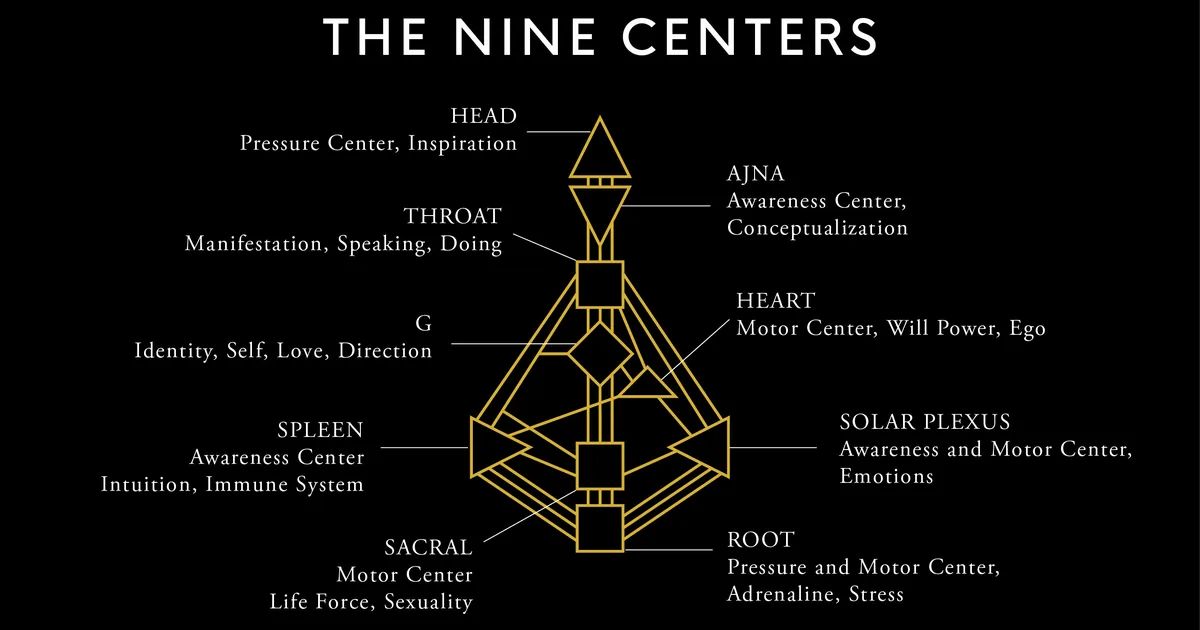
Human Design is a self-knowledge system that combines astrology, the I Ching, Kabbalah, and the chakra system. At the heart of this system is the BodyGraph, a map of your energy. It depicts nine centers — energy hubs, each responsible for specific aspects of life: from communication to intuition. Centers come in two types: defined (colored) and open (white). This does not mean one type is better than another — each has its own strengths and areas for growth. Understanding your centers helps you make decisions, build relationships, and live in harmony with your nature. In this article, we will break down how to read your centers and what to do with this information.
Defined Centers: Your Superpower
Defined centers are those that are colored on your chart. They show where you have stable, "your own" energy. These are your innate talents and ways of interacting with the world. For example, a defined Solar Plexus center means you are an emotional person, and your feelings are your compass. A defined Ajna center — you have developed intuition and the capacity for mental clarity. Defined centers are not just personality traits, but sources of strength that you can use consciously. They always work, regardless of circumstances. It's like a built-in navigator — you can trust it, but sometimes it's useful to check the map.
How to Identify Your Defined Centers
To find out your centers, you need to generate your BodyGraph. You can do this for free on many websites, for example, mybodygraph.com. You will need your date, time, and place of birth. After generating it, you will see your chart: colored centers are defined, white ones are open. Pay attention to the color: red or black — these are different aspects (conscious and unconscious). But for starters, it's enough to simply identify which centers are colored. This will give you a foundation for understanding.
Open Centers: Areas for Growth
Open centers are the white areas on the chart. They symbolize places where you don't have consistent energy, but you can "pick up" it from others. This is both a vulnerability and a potential. An open center is like an antenna: you absorb the energy of those around you, and this can be misleading. For example, if you have an open Head center, you might pick up other people's thoughts and ideas, thinking they are your own. But there is also a gift in this: you are able to deeply understand others, to see what is hidden. Open centers are places where you can gain wisdom, but only if you are aware of this process. Otherwise, they become a source of chaos and external influences.
How Open Centers Work in Daily Life
Imagine you arrive at a party. You have an open emotional center. You feel the mood of every guest, and after an hour, you no longer understand where your emotions end and theirs begin. You can become an "emotional sponge." If you are aware of this, you can use your sensitivity as a tool: you see who is sad, who is tense. But if not, you will feel tired, irritated, or anxious without reason. The same goes for an open Spleen center (intuition): you may sense danger from others, but not your own. Open centers require awareness and the practice of discernment: "Is this mine or someone else's?"
Table: Symbol vs. Meaning for Key Centers
| Symbol / Image | Traditional Meaning | Manifestation in Life | What to Do |
|---|---|---|---|
| Head center (inspiration) | Connection to ideas, mental pressure | Defined — you generate ideas; open — you absorb others' | Open: don't cling to thoughts, test them with time |
| Ajna (conceptualization) | Capacity for analysis and clarity | Defined — you have your own views; open — you easily change your mind | Open: don't rush to conclusions, ask questions |
| Throat (self-expression) | Ability to speak and act | Defined — you express yourself easily; open — you say what others expect | Open: pause before speaking, ask yourself: "Is this mine?" |
How Open and Defined Centers Influence Decisions
The main value of Human Design is its decision-making strategy. Depending on your type (Generator, Projector, Manifestor, Reflector) and authority (inner compass), you can live without fighting yourself. Centers play a key role here. For example, if you have a defined Solar Plexus center, your authority is emotional. You need to ride the emotional wave before making a decision. If you make a decision at the peak of emotion — that's a mistake. If you have an open Solar Plexus center, you should not make decisions based on emotions at all — they are not yours. Your authority is most likely located in another center.
Practice: How to Use Knowledge of Centers When Choosing
The next time an important choice arises (work, relationships, relocation), sit down and analyze your centers. For each option, ask yourself: "What does my defined center say?" For example, if you have a defined Spleen center (intuition), you might feel a physical signal — goosebumps, warmth. That is your answer. If you have an open Spleen center, don't trust the first impulse — it might be someone else's. Wait, consult with those you trust, or use a different strategy.
Myths About Open and Defined Centers
| Common Myth | Why It's Not True | How It Actually Is |
|---|---|---|
| Open centers are a weakness | Open centers provide flexibility and wisdom if you are aware of them | This is an area for growth, not a flaw. Many geniuses had open centers |
| Defined centers are a life sentence | A defined center does not mean you will always manifest its best qualities | It is potential that needs to be developed, not an automatic superpower |
| The more defined centers, the better | Many defined centers can make a person rigid and less adaptable | Balance of open and defined is the key to harmony. Each type has its advantages |
How Open Centers Connect to Other People
In Human Design, there is a concept of "electromagnetic connections": when you have an open center and another person has a defined one, you exchange energy. This can create strong attraction or conflicts. For example, if you have an open Throat center, you might fall under the influence of people with a defined Throat — they speak, and you agree, even if internally you disagree. This is not bad, but it's important to be aware of it. You can learn from such people, but not lose yourself. Practice: notice who you find easy or difficult to communicate with. Look at their BodyGraph — perhaps they "fill" your open centers. This doesn't mean you should avoid such people, but it's useful to know when you are succumbing to external influence.
Table: Before and After — Working with Open Centers
| Situation | Reactive Approach | Conscious Practice | Result |
|---|---|---|---|
| You are in a group where everyone is arguing | You absorb the aggression and feel irritated | You understand this is someone else's energy and step back | You maintain calm and clarity |
| A partner proposes a plan you don't like | You agree because you don't feel your own desires | You take a pause and check what your defined center says | You make a decision that is truly yours |
| You feel exhausted after a meeting | You think it's because of your tasks | You realize you have an open emotional center and "picked up" others' emotions | You recover faster, knowing the cause |
The "Discernment" Practice for Open Centers
This technique will help you learn to distinguish your own energy from others'. Choose one open center that bothers you most often. For example, if you have an open Head center, you notice that you constantly mull over other people's ideas. For a week, every time you catch yourself in thought, ask: "Is this my thought, or did I pick it up from someone?" If you're unsure — write it down and check the next day whether it's still yours. For an open emotional center: when you feel a strong emotion, ask: "Is this my emotion, or is it from the person next to me?" You can even physically step back and see if your state changes. This simple exercise trains awareness, and gradually you will learn to live in balance.
Special Case: Open Spleen Center
The open Spleen center is one of the most challenging. It governs intuition, health, and survival. If it is open, you can absorb other people's fears and sense danger where there is none. But on the other hand, you can feel the physical state of another person's body — this is the gift of a healer. It is important for you to learn to distinguish your own intuition from others'. Practice: when you feel sudden fear or anxiety, don't act immediately. Pause and ask yourself: "Is this my intuition, or did I pick up someone else's?" If the fear doesn't pass within a few minutes — it's not yours. Your intuition usually comes as calm knowing, without panic. Over time, you will learn to trust only that.
Your Chart Is Not a Verdict, but a Compass
When analyzing your centers, it's easy to get carried away and start looking for answers to all questions in them. But remember: Human Design is not a rigid system, but rather a map of the terrain you are walking. It helps you see where your strengths are, and where the areas are where you might stumble — but also grow. Open centers are not "holes," but an invitation to awareness. Defined ones are not a guarantee of success, but potential you can develop. Together, they create the unique pattern of your personality.
Esotericism in general is not about predictions and fears, but about deep self-understanding. When you know how your centers work, you stop fighting yourself and begin to use your energy wisely. You notice when you succumb to external influence and learn to return to your inner voice. This doesn't happen instantly, but every step of awareness makes life simpler and brighter. This is the essence of EXETERIC practices — not to run from the complex, but to understand it calmly and with respect.
If you want to go deeper into the topic, check out other practices on the EXETERIC blog — there you will find materials on chakras, astrology, and other self-knowledge systems. You might also find it interesting to check your zodiac sign — this is another key to understanding yourself. Don't be afraid of the unknown: the more you learn, the clearer your own nature becomes.
Try applying your knowledge of centers in practice. Start small: for a week, notice what emotions and thoughts arise in different situations, and ask yourself: "Is this mine or someone else's?" This simple exercise can change your perception. Remember that you are not your chart. You are the one walking the path, and the chart merely helps you choose the road. Walk calmly, trusting yourself, and may your centers become your allies, not obstacles.
Frequently Asked Questions
What does it mean if I have many open centers?
If you have many open centers, it does not mean you are weaker or worse than others. On the contrary, it makes you a very flexible and receptive person. You are able to deeply understand other people, feel their states, and see what is hidden from others. The main task is to learn to discern where your energy is and where someone else's is. Without this, you can easily fall under external influence and lose yourself. But with practice, you will turn your sensitivity into a gift — you can become a wise advisor and healer. Remember that open centers are an area for growth, not a flaw.
Can centers change over the course of life?
In Human Design, it is believed that your defined and open centers do not change with age — they are given to you at birth and remain constant for life. However, your perception of and interaction with them can change. For example, if you have an open emotional center, in your youth you might drown in others' emotions, but with experience, you will learn to calmly observe them without getting involved. Also, your centers are influenced by the people you interact with: in their presence, open centers can temporarily "fill up" with external energy. This does not change your base chart, but it changes your state. Therefore, it's important to regularly return to yourself and your nature.
How are centers related to chakras?
Centers in Human Design are often compared to chakras in the Indian tradition, but they are not the same thing. Human Design has nine centers, while the chakra system typically has seven main ones. Some centers are similar in function: for example, the Solar Plexus center is associated with emotions, much like Manipura or Anahata in the chakra system. However, Human Design is a more complex and precise system that takes into account not only energy hubs but also their defined or open state. Centers are not just points, but entire energetic mechanisms that influence how you make decisions, communicate, and act. If the topic of chakras resonates with you, studying centers can be the next step in your self-exploration.
Can you "level up" an open center and make it defined?
No, an open center cannot be made defined — it is a fundamental characteristic of your energy given at birth. But you can "level up" your awareness in that area. An open center is like an antenna that will always receive external signals. Your task is to learn to recognize these signals and not identify with them. For example, if you have an open Head center, you will always absorb others' thoughts, but you can learn not to cling to them and simply observe. Over time, you will develop the ability to distinguish your own ideas from others' and use this sensitivity for deep understanding of the world. So it's not the center that needs "leveling up," but your ability to use it.