Tarot forecast: a spread for the month in 10 minutes
What is a tarot forecast and why it works
A tarot forecast is not a prediction of fate and not an attempt to peek behind a closed door. It is a conversation with your own subconscious through a symbolic system of cards. When we ask a question and draw a Major Arcana, we do not receive a verdict — we receive an image that helps us see the situation in three dimensions. This is why the meaning of a tarot forecast is not literal, but rather mirror-like: the card reflects what is already inside us, but not yet realized.
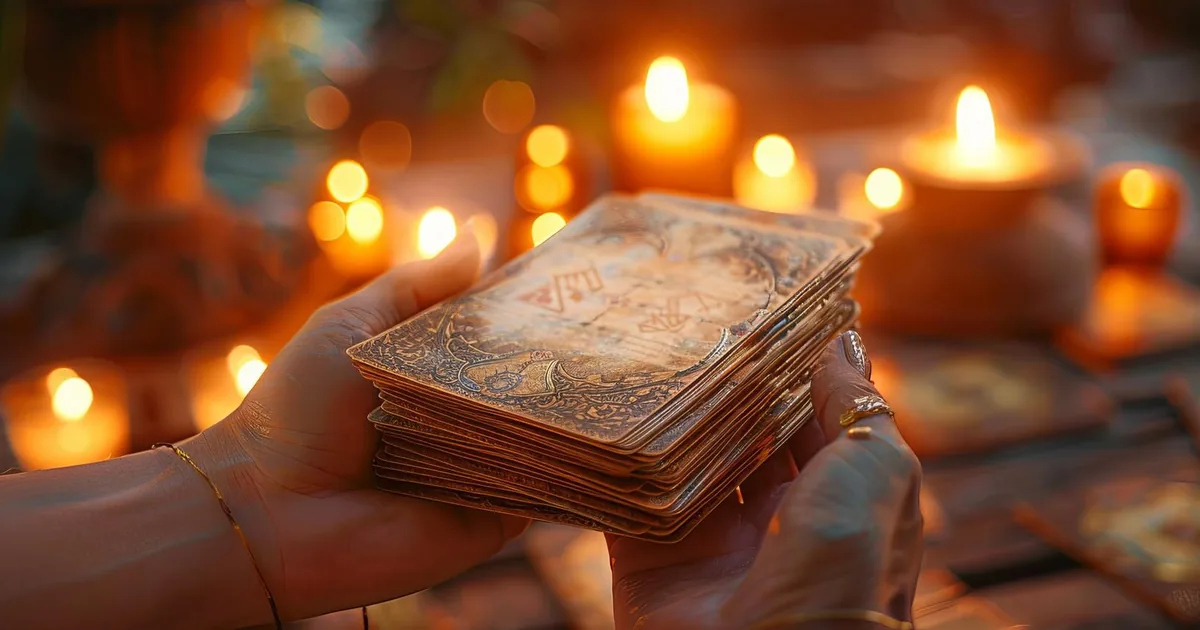
From a psychological perspective, this approach is similar to projective techniques: an ambiguous stimulus (an image) triggers an associative flow, and the person themselves completes the meaning. The esoteric tradition adds to this the idea of an energy field: the deck tunes into the vibrations of the questioner, and the drawn cards resonate with their current state. Both models do not contradict each other — they simply speak different languages about the same thing.
What is a tarot forecast in practical terms? It is a short session where you formulate an intention, shuffle the deck, lay out a few cards, and read them as a coherent story. This realistically takes 10 minutes — if you don't stage a theater with incense and don't ask the cards the same question ten times. For beginners, this is the best format: quick, clear, without unnecessary pathos.
It is important to understand: tarot forecast signs have nothing to do with fatalism. The cards do not say "it will be this way and no other." They show a probable scenario — the one that will unfold if nothing changes. And that means you always have a choice. It is at this point that esotericism stops being a scare story and becomes a tool for awareness.
Types of monthly spreads: which one to choose for your task
Tarot forecast types differ in depth, number of cards, and focus. For a monthly forecast, a complex ceremony is not needed — three to five cards are sufficient. The main thing is to decide in advance what exactly you want to see: the general background of the month, the dynamics by weeks, or a specific area (relationships, work, money).
The most universal option is the "Three Cards for the Month" spread: past/present/future or beginning/middle/end. It gives a general outline and is well-suited for a first acquaintance with the deck. If you want more details, use the "Five Cards" scheme: current situation, hidden influence, advice, challenge, outcome. This type of tarot forecast interpretation requires a little more time, but still fits within 10–15 minutes.
Separately, it is worth mentioning weekly spreads — four cards, one for each week of the month. This is convenient when there is an important project or several meetings ahead. And, of course, there are thematic spreads: for love, for career, for financial flow. Beginners are better off not spreading themselves too thin and working with one universal scheme for the first couple of months.
| Type of spread | Number of cards | What it's suitable for | Time for interpretation |
|---|---|---|---|
| Three cards | 3 | General background of the month, a quick look | 5–7 minutes |
| Five cards | 5 | Situation + hidden influences + advice | 10–12 minutes |
| Four weeks | 4 | Dynamics by weeks | 8–10 minutes |
| Thematic (love/work) | 3–5 | A specific area of life | 7–10 minutes |
If you are just starting out, do not chase complex author's schemes. A simple tarot forecast for beginners is built on three cards and an honest question. This is enough to see the picture of the month and not drown in symbols.
How to do a tarot forecast on your own in 10 minutes: a step-by-step technique
A tarot forecast on your own is a skill that is trained. The first few times you will peek at the meanings, doubt, and rephrase the question. This is normal. After 5–7 sessions, your own system will emerge: you will start recognizing cards by feeling, not by a cheat sheet.
Here is a step-by-step technique that takes exactly 10 minutes. Step one: formulate the question so that it implies development, not a "yes/no" answer. For example, not "Will I be happy in August?" but "What is important to know about August and what should I pay attention to?". Step two: shuffle the deck, thinking about your intention. You don't need to shake the cards like maracas — a calm, focused movement is enough.
Step three: lay out the chosen scheme (for example, three cards) and look at them as a whole, without reading the meanings. What is the first emotion? What catches the eye? This is your primary contact with the symbol. Step four: only now look at the interpretation of each card — but not as a dogma, but as a hint. Step five: connect the cards into one story. A month is not three separate news items, but one plot with a beginning, development, and finale.
A tarot forecast at home does not require an altar, candles, or a special time of day. One thing is required: inner silence. If you sit down for a spread in irritation or haste, the cards will answer with a jumble. If you are calm — even a simple trio will show an amazingly accurate picture.
And one more thing: do not do the same spread twice in a day. It's like asking the same question again without hearing the first answer. If the result is unsettling, put the deck away until tomorrow — the morning is wiser than the evening, and the cards know this.
Meaning of cards in a monthly forecast: how to read symbols and not get confused
The meaning of a tarot forecast is not a frozen dictionary. The same Arcana sounds different in different contexts. But there are basic guidelines that help a beginner not get lost. In a monthly spread, it is important to look at the suit and the position of the card: Major Arcana speak of fateful turns, Minor Arcana — of everyday events and moods.
For example, Cups in a monthly forecast most often indicate the emotional sphere: relationships, inspiration, creativity. Swords — thoughts, communication, sometimes conflicts and clarity. Pentacles — money, work, the body. Wands — energy, initiative, movement. If there are many cards of one suit in a spread, the month will be colored by that theme.
It is worth saying separately about reversed cards. Many beginners are afraid of them, considering them a bad sign. In reality, a reversed card is not "bad," but "energy is blocked" or "the process is going inward." For example, a reversed Empress may mean not a lack of care, but the need to first take care of yourself. How to understand a tarot forecast in such cases? Through a question: where is this energy stuck, and what will unblock it?
| Symbol / image | Traditional meaning | Manifestation in life | What to do |
|---|---|---|---|
| Cups (suit) | Emotions, relationships, intuition | Heart-to-heart conversations, falling in love, creative upsurge | Make time for feelings, do not suppress them |
| Swords (suit) | Thoughts, words, decisions | Important negotiations, clarity or arguments | Check facts, speak directly |
| Pentacles (suit) | Money, work, the body | Financial matters, everyday affairs | Plan a budget, take care of health |
| Wands (suit) | Energy, will, action | Launching projects, trips, excitement | Direct energy into specific steps |
Do not try to memorize all 78 meanings at once. Start with the suits and the Major Arcana — this will be enough for the first ten spreads. The rest will come with practice. And do not forget: tarot forecast interpretation is a dialogue, not an exam. A mistake is not punished; it simply shows where to look more closely.
Tarot forecast for August and July: seasonal nuances and what to consider
A tarot forecast for August and a tarot forecast for July have their own specifics. Summer is a time of activity, vacations, and a change of rhythm. In spreads for these months, cards of movement, travel, and new acquaintances often appear. But there is also a flip side: in the summer, it is easy to overestimate your strength and take on too many commitments.
If you are doing a tarot forecast for August 2026, pay attention to cards related to the completion of cycles. August is the last month of summer, and many processes naturally come to a close. The Wheel of Fortune, Death, the Ten of Pentacles in such a spread can indicate that it is time to close old affairs and prepare for autumn. A tarot forecast for July 2026, on the contrary, more often shows starting energies: the beginning of projects, first steps, ease.
Many are looking for a tarot forecast for August 2026 pearl or a tarot forecast for August 2026 Angela — these are requests for specific authors who publish seasonal spreads. Angela Pearl's tarot forecast is known for her general forecasts by zodiac signs. If you are close to this format, you can combine them: look at the general background from the author and do your own personal three-card spread. The general forecast gives context, the personal one gives specifics.
A tarot forecast by Angela or Angela tarot forecast 2026 should be perceived as one of many sources, not as the ultimate truth. A good forecast is one after which you understand what to pay attention to, not one that scares or promises mountains of gold. The same applies to Angela Pearl tarot forecast 2026: even experienced authors have generalizations that do not match your personal situation.
Seasonality in tarot is not magic of dates, but rather a cultural context. In the summer, we really live differently than in the winter. And the cards reflect this. Therefore, a tarot forecast for July or August may be more accurate than an abstract "forecast for the year": it takes into account your real rhythm.
Beginner mistakes: myths about tarot forecast and how to avoid them
Many myths have accumulated around the tarot forecast. Some scare with "scary cards," others promise a hundred percent prediction. Both interfere with working with the deck calmly. Let's look at the most common misconceptions — and at the same time see how the practice actually works.
First myth: "Tarot predicts only bad things." In reality, the deck reflects the entire spectrum of events. If there are many tense cards in a spread, this is not a verdict, but a signal: pay attention to this area. Second myth: "You need to have a gift, otherwise the cards won't speak." The gift here is attention and honesty with yourself. Everything else is a technique that is developed through practice.
Third myth: "You cannot do readings for yourself." You can and should, especially for training. Tarot forecast reviews often contain stories of people who were afraid to do spreads for themselves for years, and then discovered that it was personal practice that gave the most insights. Fourth myth: "Cards only work for professionals." A beginner with three cards and a clear question often gets a more accurate answer than a pro who is doing their tenth spread of the day on autopilot.
| Common myth | Why it's not so | How it really is |
|---|---|---|
| Tarot predicts only bad things | The deck reflects all events, not just threats | Tense cards are a signal to pay attention, not to panic |
| You need a special gift | The gift is attention and honesty, not a superpower | Technique is developed through practice, like any skill |
| You cannot do readings for yourself | Personal practice is the best trainer | A spread for yourself gives the most material for growth |
| Cards only work for pros | A clear question is more important than years of experience | A beginner with three cards is often more accurate than a tired pro |
Another common mistake is asking the same question to different decks or different tarot readers, hoping to get the "right" answer. This is not a search for truth, but a search for reassurance. If you don't like the answer, it's better to ask: "What can I do in this situation?" — and draw one more card as advice.
And finally: do not turn the tarot forecast into a daily ritual for any occasion. The deck is not an information service. It answers important questions, not "what should I eat for breakfast." Respect for the tool begins with respect for your own attention.
How to combine tarot forecast with other self-knowledge practices
A tarot forecast works well in conjunction with other tools. For example, with astrology: knowing your zodiac sign and current transits, you can more accurately understand why a certain theme dominates the spread. In the astrology section of EXETERIC, there are materials that help connect the cards with the position of the planets — this makes the forecast more three-dimensional.
Another powerful union is tarot and the Matrix of Destiny. The Arcana in the Matrix and the Arcana of tarot speak a similar language of symbols. If you are already familiar with the Matrix of Destiny calculator, try comparing your personal Arcana with the cards that appear most often in your spreads. Often, a surprising resonance is discovered.
For those studying Human Design, tarot can become an additional layer: the type and strategy show how you make decisions, and the cards show what exactly requires attention right now. In the Human Design guide, you can find basic analyses that will help connect these systems without eclecticism.
And, of course, do not forget about dreams. Sometimes after a spread, vivid dreams occur that continue the theme of the cards. Write them down and look in the EXETERIC dream dictionary — this helps you see how the subconscious completes the symbolic series. And if you want to go deeper, in other practices in the EXETERIC blog, there are articles on magic and self-knowledge that expand the context.
The main rule of combination: do not turn practices into a mush. Choose one main one (e.g., tarot) and one auxiliary one (astrology or dreams). This way you will maintain clarity and not drown in contradictory signals.
A monthly spread for a specific area: an example on career
When the general monthly forecast is mastered, you can move on to thematic spreads. Let's analyze an example on career — this is one of the most frequent topics of inquiry. Scheme: five cards. The first is the current situation at work. The second is hidden influence (what you are not noticing). The third is the challenge of the month. The fourth is advice. The fifth is the probable outcome if you follow the advice.
Suppose the following fell out: Eight of Pentacles (current situation), The Moon (hidden influence), Five of Swords (challenge), The Star (advice), Ace of Wands (outcome). We read it as a story. Right now you are working a lot, perhaps routinely and without brilliance — the Eight of Pentacles speaks of the process, not the result. Hidden influence — The Moon: there is uncertainty, something unsaid, perhaps you are not seeing the whole picture or someone is not being fully honest. Challenge — Five of Swords: a conflict or struggle where victory may be pyrrhic. Advice — The Star: do not lose hope, look at the long-term goal, trust your intuition. Outcome — Ace of Wands: new energy, a start, inspiration.
This spread takes 10–12 minutes but gives specific guidelines. You see that the month is not about instant success, but about patience and clarity. And most importantly — the advice of the cards (The Star) hints at where to direct attention: not into the struggle, but into restoring connection with your own desire.
Try doing the same spread in your area: relationships, finances, health. Change the questions, but keep the structure. Over time, you will notice that the cards respond not in a template way, but taking into account your context. This is why a tarot forecast is not divination in the old sense, but a practice of conscious dialogue with yourself.
And one last practical tip: after the spread, write down one summary phrase. Not the entire analysis, but one sentence that summarizes the message of the cards. In a month, reread it — and you will see how accurately the symbols described your path. This habit trains intuition better than any course.

Don't be afraid of the unknown: how to make friends with tarot and with yourself
If you have read to this point, it means the topic of tarot forecast no longer seems to you something frightening or otherworldly. And this is the most important thing that could have happened. Esotericism is generally structured this way: it does not require faith in miracles and does not punish for skepticism. It offers tools — cards, symbols, rituals — that help you hear yourself in the noise of everyday life. Tarot, in this sense, is one of the most accessible and honest tools: the deck does not flatter, does not intimidate, does not require special conditions. It simply reflects what you bring to it with your question.
Many come to tarot through anxiety: you want to know what will happen, how to act, how it will end. And this is normal. But if you stay only in this request, the cards quickly turn into a divination machine that gives answers but does not change life. The real value comes later — when you begin to notice that the cards themselves are not as important as your reaction to them. What exactly caught your attention, what you wanted to discard, where you felt a sense of recognition. At this point, esotericism stops being a prediction and becomes a practice of awareness, and the deck becomes a mirror in which you can see what is usually hidden behind the rush.
This is precisely the approach that underlies the practices of EXETERIC: not to scare, not to promise mountains of gold, but to help a person figure things out calmly and with respect. If this tone is close to you, take a look at other practices in the EXETERIC blog — there are collected materials on magic, symbols, and self-knowledge that you can study at your own pace, without pressure or obligations. And if you want to see a broader context, look at the materials in the astrology section: sometimes it is enough to look at your zodiac sign and current transits to understand why this particular theme sounds in the spreads.
Don't be afraid of the unknown. The unknown is not a sign of danger, but an invitation to figure things out. Start with three cards, with one honest question, with ten minutes of silence. Do not demand accuracy from yourself and do not compare your spreads with others'. In a month, you will reread your summary phrase and be surprised at how accurately the symbols described your path. This is magic in its most sober and warm form: not power over fate, but attention to your own life. Try it — calmly, consciously, and with respect for yourself.
Frequently Asked Questions
How many cards are enough for a monthly spread?
For a monthly forecast, three cards are most often enough: they give a general outline and show in what mood the month will pass. If you want more specifics, you can take five cards — then, in addition to the general background, there will be hidden influences, a challenge, and advice. Four cards are convenient when you want to break down the month by weeks. More than seven cards for a monthly horizon are usually not needed: you will simply drown in details and lose the main line. Beginners are better off stopping at three and not complicating things.
Can I do a monthly spread if I am a complete beginner?
Yes, and this is the best way to start. A monthly spread does not require deep knowledge of all seventy-eight Arcana — it is enough to understand the suits and the general meanings of the Major Arcana. Start with a simple three-card scheme and one honest question. The first sessions will involve peeking at a cheat sheet, and this is normal. After five to seven spreads, you will start recognizing cards by feeling, not by memory. The main thing is not to chase complex author's schemes until you have mastered the basics.
What should I do if alarming cards appear?
Alarming cards are not a verdict or a warning of catastrophe. In tarot, they most often indicate an area that requires attention: conflict, fatigue, something unsaid, fear. Perceive such a card as a signal, not as a punishment. Ask yourself: what in this area can I change or at least see more clearly? If you don't like the answer, draw an additional card with the question "what will help me." This way you turn fear into a specific step, not a reason for panic.
How often can I do a monthly forecast for myself?
Optimally — once at the beginning of the month, when you want to see the general background and set priorities. Doing a spread every day on the same question is pointless: you are simply asking the cards again without hearing the first answer. If the result is unsettling, put the deck away until the next day and return to it with a fresh head. During the month, you can do short clarifying spreads for specific situations, but do not turn the deck into an information service. Respect for the tool begins with respect for your own attention.