Tarot reading online: free spreads for love and the future
Online Tarot Reading: How It Works and Why It's More Than Just a Prediction
When we say "tarot reading online," many people picture a flickering screen, a virtual deck, and a mysterious stranger who "knows everything." But in reality, online readings are not just a digital version of cards. They are a bridge between your subconscious and that part of you that usually stays silent amid the hustle and bustle of everyday life. Tarot cards are not pure magic but rather a mirror that reflects your true desires, fears, and possibilities. And when you read tarot online, you don't receive a ready-made answer — you learn to ask the right questions.

From an esoteric perspective, Tarot works with archetypes — universal images that live in the collective unconscious. Each card is not "fate" but rather an energetic pattern that can manifest in your life if you pay attention to it. For example, the Empress is not just "pregnancy" or "creativity" but an invitation to nurture something new, whether it's a project, a relationship, or an inner state. When you do a reading online, it's as if you're starting a dialogue with these archetypes.
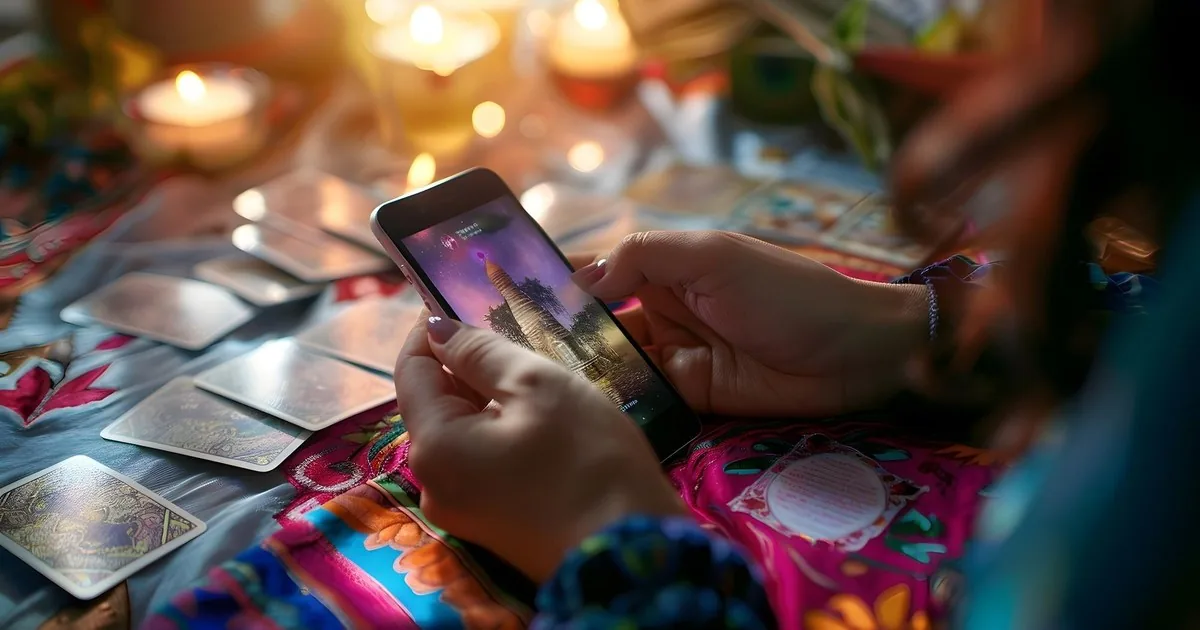
But why online specifically? In traditional practice, a tarot reader holds the cards in their hands, feeling their warmth. In the online format, this physical contact is replaced by concentration on intention. You formulate your question, choose cards from a virtual deck — and your subconscious still "sees" them. Many modern tarot readers believe that digital readings work even more accurately because there are fewer distractions: you remain alone with yourself and your thoughts.
Psychologists explain this through the projection effect: when you look at a randomly chosen card, you unconsciously connect it to your situation, and this helps you see a solution that was already within you. So tarot reading online is not an attempt to find out "what will happen" but a way to hear your inner voice.
If you're a beginner, start with simple questions: "What do I need to understand in this situation?" or "What energy currently prevails in my relationships?" Avoid yes/no questions — Tarot speaks in images, not facts. And remember: no card is "bad." Even the Tower, which frightens many, symbolizes the destruction of illusions and liberation from the old — and that is often the beginning of something new.
Online readings are especially valuable because they are available at any time. You can do a reading at midnight when your thoughts are especially clear, or during a lunch break when you need a pause. The main thing is to follow simple rules: tune in, formulate your question, and don't ask the cards about the same matter more than once a month. Otherwise, you risk getting tangled in your own expectations.
Free Tarot Readings Online: Truth or Marketing?
The phrase "free tarot reading online" makes many people skeptical. It seems like something hidden always lurks behind anything free: either they'll ask for money later, or you'll get a generic template answer. But in reality, free online readings are not just a marketing gimmick — they are a fully functional tool if you approach them wisely.
First, free services often use algorithms that randomly select cards from the deck. This is not a "lazy" approach but rather a modern interpretation of traditional shuffling. The chance of drawing the card you need is the same as with a physical reading. Everything depends on your intention and state of mind.
Second, many websites offer not just one reading but an entire library: for love, for the future, for career, for upcoming events. You can choose the one that resonates with your question. For example, the "Celtic Cross" spread is suitable for deep analysis of a situation, while "Three Cards" is perfect for a quick answer to "what was, what is, what will be."
But there are also pitfalls. Free services often rely on generic interpretations that fit everyone and no one. So don't treat the text you receive as the ultimate truth. Instead, write down the cards you drew and try to interpret them yourself, relying on your own feelings. For example, if the Five of Pentacles appears, which traditionally speaks of material difficulties, think: in which area do you feel "cold" — finances, relationships, or self-esteem?
Another point: free readings may be limited in quantity or functionality. For instance, you might only be able to do one reading per day, or you'll be offered a subscription for "full access." This is normal — that's how services earn their keep. But for basic practice, free features are usually sufficient.
If you want to try tarot card reading online, start with simple services that don't require registration. Formulate your question, choose a spread, and take a deep breath before clicking "get answer." After the cards appear, spend 5-10 minutes reflecting: what do you feel, what thoughts come to mind, what images surface. Write down your observations — this will help you later track how the reading correlates with real events.
And remember an important principle: Tarot doesn't rigidly predict the future; it shows the most likely tendencies given the current state of affairs. By changing your behavior, you can change the outcome. So a free reading is not a verdict but a reason for reflection.
Online Tarot Reading for the Future: How to Know What Lies Ahead
One of the most popular requests is online tarot reading for the future. People want to know what awaits them: a new job, a move, meeting a partner, or, on the contrary, difficulties. But the future in Tarot is not a black box — it's more like a map of the terrain with several paths. An online reading for the future helps illuminate these paths and understand which one leads to what you desire.
For such readings, spreads that show a time perspective work best: "Past-Present-Future," "Wheel of the Year," or "12 Houses." In these, each position corresponds to a specific period or area of life. For example, in the "Three Cards" spread, the first card is past influences, the second is the current situation, and the third is the likely development of events if you change nothing.
Interestingly, in the online format, such spreads often come with detailed interpretations that account for both upright and reversed card positions. A reversed card is not always negative — it's more of an indication of delay, inner conflict, or the need to reconsider your approach. For example, the reversed Moon may suggest that you're deceiving yourself about something, while the upright Moon indicates that the situation is still unclear and you need to trust your intuition.
When you read about the future, it's important not to fixate on specific dates. Tarot operates in periods: "soon," "in the near future," "in a few months." If you ask "when will I meet my love?" the cards may show that you first need to deal with past grievances, and then the meeting will happen sooner. Or that you are too closed off to new acquaintances, and the energy cannot enter your life.
Psychologically, reading about the future helps reduce anxiety: when you see possible scenarios, you stop fearing the unknown and start acting more consciously. For example, if the reading shows financial difficulties in the coming month, you can save money in advance or look for an additional source of income. This is not "fate" but a warning that gives you a chance to prepare.
Practical advice: don't do more than one reading about the future per day. Your brain needs time to "digest" the information. And don't ask the same question on different services — it will only confuse you. Better to choose one resource that resonates with you and use it regularly to track the dynamics.
Online Tarot Reading About a Man: What He Thinks and Feels
Relationships are perhaps the most emotional topic for readings. The request "online tarot reading about a man" is one of the most frequent. Women want to understand what's going on in their partner's head, what his true feelings are, and whether to continue the relationship. Tarot can provide answers, but it's important to approach this consciously.
When you do a reading about a man, you're not "reading his mind" in the literal sense. Rather, you're tuning into the energy of your connection and receiving hints about his state through the cards. For example, if the Knight of Swords appears, it may indicate that he is currently focused on work or his goals and isn't ready for deep conversations. The Queen of Cups, on the other hand, suggests that he values emotional closeness but perhaps doesn't show it.
Online readings about a man typically include positions such as: "what he thinks about me," "what he feels," "what he hides," "how the relationship will develop." It's important to remember that the cards show the current moment, not an eternal truth. People change, feelings evolve, and what you saw today may be outdated in a month.
The main rule is not to use Tarot for control or manipulation. If you read to "catch" a man in a lie or to make him love you, the cards will reflect your anxiety rather than the real situation. Better to ask: "What do I need to understand about our relationship?" or "What energy is between us right now?" This approach will give a more honest answer.
If you get an ambiguous result, don't panic. For example, if the Three of Swords appears (broken heart), it doesn't necessarily mean a breakup. Perhaps there are old wounds in the relationship that need healing, and if you're both willing to work on it, everything can improve. Use the reading as a reason for a conversation with your partner, not as a verdict.
For an online tarot reading about a man, spreads with clear positions work best, such as "Love Triangle" (if there's a rival) or "What He Thinks About Us." But don't overdo it: overly detailed readings can create a dependency on constant reassurance. Trust yourself more than the cards.
Online Tarot Reading for the Near Future: What Will Happen in the Coming Days
Sometimes you want to look not years ahead but just days or weeks. For this, there's the "near future" spread. It answers questions like: "what awaits me this week?", "how will the important meeting go?", "should I plan a trip?" Online tarot reading for the near future is like a short weather forecast, but for events.
Such a spread usually consists of 3-5 cards that describe the development of events in the near term. For example, the first card covers the next 1-3 days, the second — until the end of the week, the third — the following week. It's important to understand that Tarot doesn't predict exact dates but rather shows the energetic background against which events will unfold.
For example, if the Eight of Wands appears, it speaks of rapid movement, news, unexpected turns. You might receive a message that changes your plans. If the Four of Cups appears, it's the opposite — a period of stagnation and apathy, when it's better not to force events but to focus on inner peace.
Psychologically, such a reading helps structure expectations: you know the coming days will be eventful, and you prepare for it. Or you understand that you need to take a pause and don't waste energy on useless actions.
For online practice, choose the "Upcoming Events" or "Weekly Forecast" spread. Formulate your question specifically: "What should I expect in the next 7 days?" or "What's important to know about the upcoming meeting?" After receiving the answer, write it down and check it against reality in a week. This way, you'll learn to understand the language of Tarot and trust your intuition.
But remember: a near-future reading is not a reason to cancel plans if a "bad" card appears. Rather, it's an opportunity to prepare. If the card speaks of conflict, you can think through how to avoid or soften it. Tarot is a tool for conscious living, not for passive waiting.
How to Choose an Online Service: What to Look For
Today, there are thousands of websites on the internet where you can read tarot online. But not all of them are equally useful. To avoid disappointment and wasted time, choose services consciously. Here are a few criteria to help distinguish a quality resource from a dubious one.
| Criterion | Good Service | Dubious Service |
|---|---|---|
| Design | Pleasant, calm, without flashing banners | Loud colors, intrusive ads, pop-up windows |
| Interpretations | Detailed, with various meanings | Template phrases that fit everyone |
| Privacy | Doesn't require registration or gives you a choice | Requests personal data unnecessarily |
| Cost | Clearly states what's free and what's paid | Hidden fees, "free" only with subscription |
Also pay attention to reviews. If people write that the service "comes true," that's good, but remember that subjective experience can vary. Better to try several different services and choose the one where you feel most comfortable. Trust in the tool is an important part of the practice.
Another nuance: some services offer "tarot reading online" with a live tarot reader. This is a different format that costs money but provides a deeper analysis. If you're a beginner, start with free algorithms, and once you get comfortable, you might want to consult a specialist.
And don't forget about safety. Don't enter your passport details or bank card numbers on such websites unless you're sure of the resource's reliability. Honest services don't require this for a simple reading.
Practice: How to Ask Questions and Interpret Cards Correctly
The foundation of any reading is the right question. The quality of the answer depends on how you formulate it. Here are a few rules to help you get the most out of an online reading.
- Formulate open-ended questions: "What do I need to know about...?" instead of "Yes or no?"
- Don't ask questions about other people without their consent: "What does he feel?" is better replaced with "What's important for me to understand about our relationship?"
- Focus on one question at a time. If there are several, do several readings.
When you receive the cards, don't rush to read the ready-made interpretation. First, look at the cards and write down your first associations. What do you feel? What images come to mind? Then compare with the classical meaning. Perhaps you'll see something of your own that isn't described in the standard interpretation.
For example, if Death appears, don't be afraid. It's not about physical death but about transformation, the end of one stage and the beginning of another. Ask yourself: what in my life is "dying" to make room for something new? Maybe an old habit, a job, or a relationship that has outlived itself.
Reversed cards also matter. They often indicate inner conflict, delay, or distortion of energy. For example, the reversed Strength may suggest that you doubt your abilities even though you actually have them. Pay attention to your feelings: if a card causes fear, perhaps you're avoiding some aspect of yourself.
Finally, keep a reading journal. Write down the date, question, cards drawn, and your thoughts. After a month, reread it and see what came true. This will help you understand how Tarot works personally for you and learn to trust your interpretations.
Tarot as the Language of Your Soul: From Predictions to Conscious Living
When you first discover the world of Tarot, whether online or offline, it's easy to get caught up in seeking answers to specific questions: will I meet my love, will I get a promotion, should I move. But with practice, you begin to notice something greater. The cards become not just a prediction tool but a kind of language through which your intuition speaks to you. This is not magic that decides everything for you but rather a mirror reflecting your deep states, fears, and dreams. That's why it's so important to approach reading consciously, with respect and without fanaticism.
Our media project EXETERIC is created for those who want to explore esotericism intelligently, without prejudice and superstition. We don't promise instant miracles or scare you with karmic retribution. Instead, we offer you a systematic view of ancient practices — from Tarot to astrology — and help you integrate them into everyday life. If you feel ready for a deeper dive, check out EXETERIC practices — there you'll find not only readings but also philosophical foundations that will turn divination into a tool for self-discovery.
Remember: Tarot doesn't dictate fate. It shows the most likely scenarios given the current arrangement of energies, but you always have the freedom to choose. If the reading turned out differently than you hoped, it's not a verdict but an invitation to action. For example, if the cards indicate a possible conflict, you can think ahead about how to soften or avoid it. If they speak of stagnation, that's a signal that it's time to change something. This approach turns divination from passive waiting into active creation of your life.
The online format is especially good because it allows you to practice anytime, anywhere. You can do a quick reading during a lunch break or a deep analysis before bed. But don't forget: the quality of practice depends not on the number of readings but on your inner state. Before a session, spend a few minutes on breathing, formulate a clear question, and set aside excessive expectations. And be sure to keep a journal — write down the cards drawn, your thoughts, and subsequent events. This will help you track how Tarot works personally for you, and over time you'll learn to trust your intuition.
If you want to expand your knowledge and try other approaches to divination, check out other practices in the EXETERIC blog. There you'll find articles on runes, astrology, numerology, and other esoteric systems. Each of them is another key to understanding yourself and the world. And perhaps you'll want to explore the astrology section and see what the stars say about your zodiac sign. It's a great way to complement card readings with astrological insights.
Ultimately, Tarot is not about finding out "what will be." It's about hearing your inner voice, which is often drowned out by the noise of daily life. The cards are simply a mediator between your conscious and subconscious mind. Don't fear the unknown — trust the process, but keep your common sense. And remember: true magic happens when you combine ancient wisdom with conscious actions in the present. May your readings be clear and your decisions wise.
Frequently Asked Questions
Can you do a tarot reading online for free and get truthful results?
Yes, free online tarot readings can be truthful, but it's important to understand that their accuracy depends on your mindset and the quality of the service. Many websites use real random card selection algorithms that simulate deck shuffling, so the chance of getting the card you need is the same as with a physical reading. However, free services often provide generic interpretations that fit everyone and no one. To increase accuracy, formulate a specific question, focus on it before selecting cards, and then analyze the drawn cards based on your own feelings. If the answer seems too vague, try another service or do the reading again after a few days.
Which online Tarot spread is best for a question about love?
For love questions, spreads that show the dynamics of the relationship and the partner's feelings work great. For example, the classic "Celtic Cross" provides a deep analysis of the situation, including hidden influences and possible outcomes. A simpler and faster option is the "Three Cards" spread, where the first card indicates the past, the second — the present, and the third — the likely future. Also popular are the "Love Triangle" spread, if there's a rival, and "What He Thinks About Me," which focuses on a specific person's thoughts and feelings. The main thing is to formulate your question clearly, for example: "What do I need to know about my relationship with this person?" — and choose a spread that resonates with your request.
Can Tarot cards predict the exact date of an event?
Tarot cards rarely indicate exact dates, and this is not their strength. Tarot operates with energies and tendencies, so answers are usually phrased as "soon," "in the near future," "in a month," or "within a year." Specific timelines can be seen in spreads specifically designed for time frames, such as "12 Houses" or "Wheel of the Year," but even these give approximate periods rather than exact numbers. This is because the future is multi-variant and depends on many factors, including your own actions. Instead of seeking a date, focus on what you need to do to bring the desired event closer or prepare for it.
Why do different online tarot readings give contradictory answers to the same question?
Contradictions in answers are normal, and here's why. Each reading reflects an energetic snapshot of the moment, and energy constantly changes. Additionally, different services use different algorithms, decks, and interpretations, which also affects the result. Your own state and the phrasing of the question can vary from session to session, which also leads to different answers. Tarot doesn't show a single "truth" but rather offers several possible scenarios that depend on your actions. So don't ask the same question many times in a row — it only confuses things. Better to choose one service and one spread that you trust and work with it. If the answers still contradict each other, take a pause and return to the question after a few days when you're calmer and more focused.