Waite tarot: a deck for beginners — breakdown and first spreads
Why the Waite tarot — and why a beginner doesn't need another deck
If you are just entering the world of divination practices, sooner or later you will face the question: which deck to choose? The answer is almost always the same — Waite tarot. This is a classic deck that has remained the gold standard for learning since 1909. Not because it is "the best" in some esoteric sense, but because it is the most accessible: it has illustrations, every image has a story, and from that story you can guess the meaning of the card even without memorization.
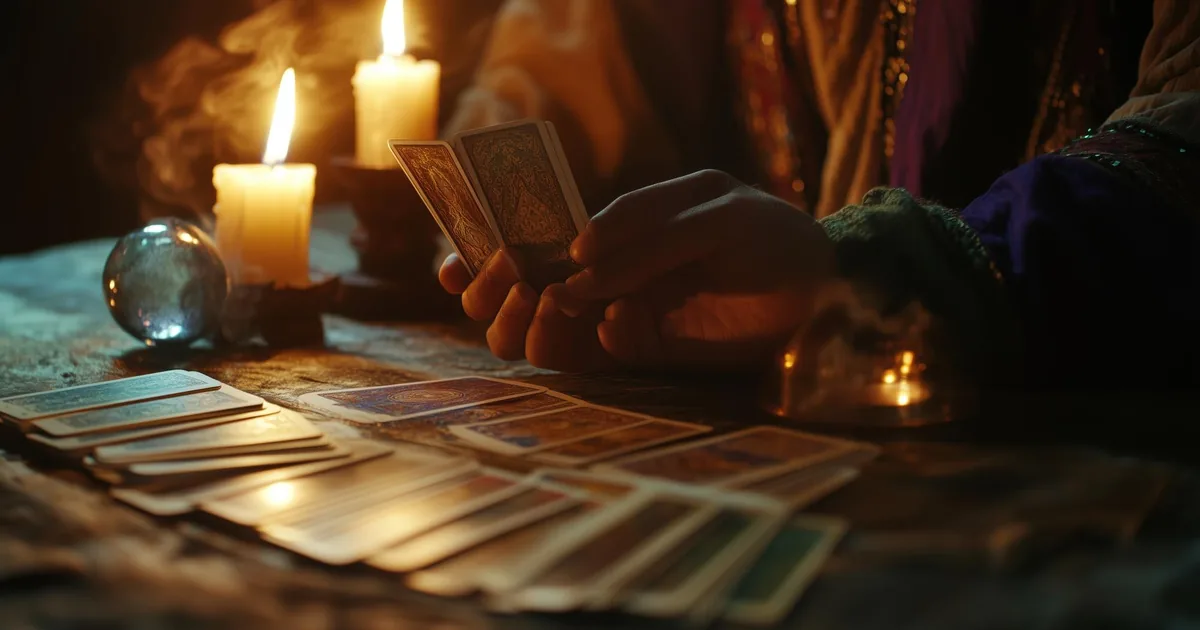
Imagine the difference: one deck is a set of abstract symbols that must be memorized by heart, another is a set of small paintings in which a person sees a story. The Knight is riding, the Fool is walking toward the cliff, the High Priestess sits behind the veil. Waite tarot cards literally tell you their story — and that is precisely why they became the foundation for most books, courses, and reference guides on interpretation.
Another reason for their popularity: Waite tarot for beginners is not just marketing, but a real opportunity to quickly enter practice. There is a huge number of resources where every meaning of Waite tarot cards is described, with ready-made tables, breakdowns, and study materials. You are not left alone with the deck — an entire ecosystem of knowledge is built around it.
There is also a third factor that is rarely mentioned: the Waite deck was created as a universal language. Its symbols resonate with astrology, the Kabbalah, and alchemy. If you ever look at the astrology section, you will notice that planets and zodiac signs repeat on the cards — for example, the Star card bears the symbol of Astarte, and the Wheel of Fortune bears a Kabbalistic key. This means that by studying tarot, you simultaneously gain access to a wider spectrum of esoteric knowledge.
So if you are standing before a choice — start with this deck. Not because it is "sacred," but because it is made so that a beginner can understand it in a few evenings, not a few years.
Deck structure: 78 cards and how they are arranged
Before moving on to the Waite tarot spread, you need to understand exactly what you are holding in your hands. The deck consists of 78 cards divided into two groups: the Major Arcana and the Minor Arcana. This is not just a classification — these are two fundamentally different levels of work.
Major Arcana (22 cards) — these are major events, archetypes, turning points. The Fool, the Magician, the High Priestess, the Empress — each card embodies a certain stage of the spiritual path. When a Major Arcana card appears in a spread, it is a signal: something significant is happening, something that goes beyond everyday trifles.
Minor Arcana (56 cards) — these are four suits, with 14 cards in each. This is where everyday life lives: work, relationships, emotions, conflicts. Meaning of Waite tarot cards for beginners is easiest to begin studying with the Minor Arcana, because their logic is transparent: each suit is responsible for a certain sphere.
| Suit | Element | Sphere of life | Example card |
|---|---|---|---|
| Swords | Air | Thoughts, conflicts, decisions | Five of Swords |
| Wands | Fire | Energy, action, ambitions | Three of Wands |
| Cups | Water | Emotions, relationships, intuition | Six of Cups |
| Pentacles | Earth | Material world, work, health | Ten of Pentacles |
It is important to understand: meaning of reversed Waite tarot cards is not a "bad card." A reversed position merely modifies the upright meaning: it strengthens, weakens, or distorts it. Some practitioners do not work with reversed cards at all, and that is fine — but we will talk about that later.
Each of the 78 cards has its own meaning, and Waite tarot cards meaning of each card can be studied gradually: start with the ten cards that come up for you most often, and gradually expand your vocabulary. You don't need to memorize everything in a week — this is a marathon, not a sprint.
Meaning of Waite tarot cards: how to read symbols, not memorize texts
The main beginner's mistake is trying to memorize each meaning of Waite tarot cards like a memorized textbook passage. This approach works for the first two weeks, and then it falls apart, because real spreads are rarely as simple as the examples.
The right approach is to learn to read symbols. Look at the "Five of Swords" card: on it are five swords, three of which a person is taking away, while two remain on the ground. What do you see? A victory, but an empty one. The person achieved their goal, but at the cost of relationships or honesty. Here is your interpretation of Waite tarot — not a memorized phrase, but a living observation of the picture.
Let's break down how this works using the four suits as examples. Meaning of Waite tarot swords cards — this is the world of thoughts and conflicts. Two of Swords — a person with closed eyes, holding two swords crossed: a refusal to see the situation, a deadlock, "I don't want to decide." Three of Swords — a broken heart, betrayal, pain. Each card visually tells you what is happening in a person's head.
Meaning of Waite tarot wands cards — this is the world of energy and action. Three of Wands — three masts of a ship, ready to set sail: planning, waiting for the moment, potential. Six of Wands — triumph, recognition, "I made it." If swords tell you what you think, then wands tell you what you do.
Waite tarot cups cards meaning — this is the sphere of emotions and relationships. Four of Cups — a person sits with arms crossed and does not notice the fourth cup being offered to them: apathy, satiation, "I don't need anything." Seven of Cups — fantasies, illusions, many options, none of which is real. Cups answer the question "what do you feel."
Tarot cards meaning Waite pentacles — this is the world of the material: money, work, health, home. Seven of Pentacles — a person looks at the coins grown on the bush and waits: patience, investment, "it's not time to harvest yet." Ten of Pentacles — family, legacy, stability, "everything is already built."
To memorize Waite tarot interpretation and meaning of cards not as dry theory but as a living skill, try a simple technique: take one card, look at it for thirty seconds, close your eyes, and describe aloud what you see. Then open the reference guide and compare. You will be surprised how many matches there are — because symbols work through the subconscious, and your intuition already knows more than you think.
First Waite tarot spreads: where to start your practice
Now that you understand the deck structure and can read symbols, it's time to move on to practice. A Waite tarot spread for a beginner should be simple: three or four cards, a specific question, a clear position for each card. You don't need to start with the Celtic Cross — that's like learning to swim in the ocean.
Waite tarot yes or no — this is the first type of spread that most people master. The logic is simple: you ask a question, draw one card, and look at the answer. Upright position — "yes," reversed — "no." But there's a nuance here: tarot is not a binary tool. Sometimes a card says "yes, but on condition" or "no, but in the long run — yes." Therefore, Waite tarot for beginners is better to start not with "yes-no" questions, but with spreads where each card has its own role.
Here are three simple spreads we recommend starting with:
- Card of the day. Draw one card in the morning and spend the day looking for how its symbols manifest in your life. This trains intuition and teaches you to notice signs.
- Three cards: past — present — future. A classic spread where each position is responsible for a time period. Simple but informative.
- Three cards: situation — action — result. A more practical option: the first card describes the context, the second — what to do, the third — where it will lead.
Before each spread, it is important to formulate an intention. This is not a ritual for the sake of ritual — it is a way to tune your subconscious to the right wavelength. Ask yourself: "What do I want to know?" — and ask the question clearly. A vague question like "what awaits me?" will give a vague answer. A specific question like "how should I act in the situation with my work?" — a specific card.
After the spread, write down the result. Seriously — take a notebook and write: the date, the question, the cards, your first reaction. In a month you will return to these notes and see how often the interpretation matched reality. This is the best way to test your intuition and confirm that interpretation of Waite tarot is a skill that develops, not a gift you either have or don't.
Reversed cards: to work with them or not
One of the most frequent beginner questions: should you take into account the meaning of reversed Waite tarot cards? The answer depends on your level and style of work, but let's break down both approaches.
Approach one — upright positions only. Many classic interpretations (including classic Waite tarot card meanings) are based exclusively on the upright position. The logic: each card already has a sufficiently rich meaning, and reversing it means adding unnecessary complexity. For a beginner this is reasonable: it's easier to master 78 upright meanings than 156 (78 upright + 78 reversed).
Approach two — with reversals. A reversed card adds a nuance: a blockage, a delay, an internal experience instead of an external one. For example, upright Ten of Pentacles — stability and legacy; reversed — family problems, financial instability, "the house is falling apart." Meaning of reversed Waite tarot cards does not cancel the upright meaning, but modifies it.
| Approach | What it takes into account | Difficulty for a beginner | When to choose it |
|---|---|---|---|
| Upright only | 78 meanings | Low | The first 1-3 months of practice |
| With reversals | 156 meanings | High | After confident knowledge of the uprights |
Our recommendation for Waite tarot for beginners: start with upright positions, and add reversals gradually — when the upright meaning of each card becomes so familiar to you that you feel the difference intuitively. Then the reversal of a card will not be an "additional rule," but a natural signal: "attention, something here is not as it seems."
Another important nuance: a reversed card does not always mean "bad." Sometimes it is simply an internal state instead of an external one. Upright High Priestess — wisdom and a secret that you possess; reversed High Priestess — a secret that possesses you: hidden motives, deception, "something is wrong, but I don't understand what." The difference is subtle but fundamental.
Interpretation in context: how card combinations change meaning
A single card is a word. Two cards side by side are a phrase. A spread of three or four cards is a sentence. Waite tarot cards meaning card combinations — this is what turns a set of separate interpretations into a living story.
Let's take a simple example. Suppose, in a "situation — action — result" spread, the following came up: Five of Swords, Three of Wands, and Six of Cups. Individually: conflict, planning, nostalgia. But together? "There is a conflict in the situation (Five of Swords), and the best action is to plan a way out (Three of Wands), and the result is a return to something kind and familiar (Six of Cups)." Do you see how interpretation of Waite tarot turns from three isolated answers into a coherent narrative?
For this to work, several principles need to be taken into account:
- Position matters more than the card. The same card in the "result" position sounds different than in the "situation" position. Five of Swords as "result" — a conflict you will arrive at; as "situation" — a conflict you are already in.
- Dominant suit. If three cards in a spread are from the same suit, it is a signal that the sphere of that suit dominates. Three Swords cards — the situation is heavily "in your head," you think more than you act.
- Orientation of the reversals. If all cards are reversed — this can mean an internal block, "I'm not ready to act." If all are upright — external circumstances are falling into place.
Waite tarot cards meaning and interpretation of each card is only the first step. The second step is learning to see the connections between cards. The third is understanding how the position in a spread affects what the card "says." And only after that does Waite tarot interpretation stop being memorization and become a genuine reading skill.
Try it right now: take three random cards, lay them out in a row, and try to compose one coherent phrase from them. Don't look for the "correct" answer — look for meaning. This exercise trains exactly the skill that distinguishes a beginner from a practitioner: the ability to see the whole, not just the separate parts.
Waite tarot and relationships: how to read cards about feelings
One of the most frequent requests is Waite tarot cards meaning relationships. People want to know: does he love me, will there be compatibility, what does the other person feel. This is natural — relationships are one of the strongest spheres where we seek clarity.
But there is an important nuance here that is rarely discussed: tarot does not read other people's thoughts. It shows the energetics of the situation — how you feel about what is happening between you. If you ask "does he love me?", the card will show not his feelings, but your intuition about those feelings. This is not deception — it is a different principle of operation.
Here are the cards that most often come up in relationship spreads and what they mean:
| Card | Meaning in relationships | What to do |
|---|---|---|
| Two of Cups | Mutuality, harmony, "we are together" | Strengthen the bond, don't be afraid of closeness |
| Queen of Cups | Emotional maturity, care | Express emotions openly |
| Five of Cups | Loss, grief, "I can't forget" | Work through the grief, don't get stuck |
| Three of Swords | Betrayal, rupture, pain | Accept the fact, don't look for someone to blame |
| The Moon | Illusions, deception, "I don't see clearly" | Check your assumptions |
Waite tarot meaning in the context of relationships is not a verdict, but a mirror. The card doesn't say "you will break up," it says "here is what is happening with your emotional sphere right now." The decision is always yours. This is a fundamental difference between conscious practice and superstition: superstition says "the card decided," consciousness says "the card hinted, and I decide."
Practical advice: if you often do readings on relationships, keep a journal. Write down the date, the question, the cards, and what actually happened. After a few months you will see patterns: which cards match reality and which don't. This will help you understand that meaning of Waite tarot cards for beginners in the context of relationships is not magic, but a tool for self-knowledge.
Waite tarot for beginners: the path from your first spread to confident practice
Let's put it all together and look at what a beginner's path looks like from the first card to confident reading. This is not a staircase to be climbed in a month — it is a spiral where you return to the same cards again and again, each time with new understanding.
Weeks 1-2: getting acquainted. Take the deck, lay out all 78 cards in front of you, and just look. Don't read meanings — just look. Which cards resonate with you? Which ones repel you? Which ones spark curiosity? This is your first connection with the deck: not intellectual, but emotional.
Weeks 3-4: studying the structure. Divide the cards into Major and Minor Arcana, then into four suits. Find out which suit is responsible for which sphere. At this stage you can already do simple "card of the day" spreads and start keeping a journal.
Month 2: your first meaningful spreads. Move on to three-card spreads. Start taking into account Waite tarot cards meaning of each card in the context of its position. Try answering the question "what do I feel?" and compare the card with your real emotions.
Month 3 and beyond: deepening. Add reversed cards, start working with combinations, try five- to seven-card spreads. By this point Waite tarot interpretation should stop being "reading from a reference guide" and become a natural process: you look at a card and feel what it is saying.
Another important aspect: don't be afraid of making mistakes. Every tarot practitioner — from beginner to professional — makes mistakes. What matters is not that you got it wrong, but that you wrote down the result and came back to it. After half a year of such notes you will have your own database: Waite tarot interpretation and meaning of cards in your personal experience — that is priceless.
And if you want to broaden your horizons beyond tarot, take a look at other practices on the EXETERIC blog — there you will find materials on runes, astrology, and self-knowledge that will complement your work with the deck.
Waite tarot yes or no: how to ask questions to get an honest answer
The "yes-no" format is the most popular and the most dangerous format for a beginner. Popular because it's simple, dangerous because it turns tarot into an oracle that "decides for you." Let's break down how to use Waite tarot yes or no consciously.
The problem starts with how the question is phrased. "Will I be happy?" — a bad question: it's vague, has no time frame, and gives you no action. "Should I take this job next month?" — a good question: specific, bounded, with the possibility of acting.
Here's how to tell a good question from a bad one:
| Bad question | Why it doesn't work | Good question |
|---|---|---|
| "Will I be happy?" | Vague, no time frame | "What do I need to do to feel happier this year?" |
| "Does he love me?" | Reads another person's thoughts | "What do I feel in this relationship, and what should I do about it?" |
| "Will I die?" | Fear, not a question | "How should I take care of my health in the near future?" |
When the question is phrased correctly, Waite tarot for beginners in the "yes-no" format works differently: the card doesn't just answer "yes" or "no," it shows a condition. Let's say the question is: "Should I move?" — an upright Seven of Pentacles comes up: "Yes, but not now — first wait until your current investments bear fruit." Or a reversed Three of Wands: "No — you're not ready yet, the plan is immature."
Practical step: before asking a "yes-no" question, write it down on paper. Read it aloud. If the question causes you anxiety — rephrase it. An anxious question ties you to fear, and the card will reflect the fear, not the situation. A calm, specific question is a clean signal, and the interpretation of Waite tarot will be more accurate.
And lastly: don't ask the same question twice. If the answer didn't satisfy you and you want to "redraw" — that means you're not looking for an answer, but for confirmation of your desire. In that case, tarot stops being a tool of self-knowledge and becomes a tool of self-deception. Better to put the deck aside and return to the question in a week — with a clear head and a fresh perspective.
When the deck becomes a mirror: what's next with Waite tarot
You've made it to the end of this article — and that already says something. Not that you "believed in magic," but that you want to understand how the tool works before using it. This is a rare and valuable quality, and it is with this attitude that Waite tarot for beginners opens up fastest.
We want to ease any possible tension right away: tarot is not a panacea and not a verdict. The deck does not solve your life, does not predict your fate, and does not replace a doctor, a psychologist, or common sense. What it does do is help you see what you already know but don't want to or can't admit out loud. The card becomes a mirror: in it is reflected your state, your intuition, your subconscious. And that is precisely why interpretation of Waite tarot works best when you approach it calmly, without fear and without expecting a miracle.
In the EXETERIC practice we always adhere to one principle: esotericism is a language of self-knowledge, not a way to dodge responsibility. If after a spread you understand that you need to act — act. If the card shows an internal block — work through it, rather than pulling another spread in hopes of a different answer. Conscious practice is when the tool helps you think more clearly, rather than replacing your thinking.
If you're curious how tarot intersects with other esoteric systems — for example, how the symbols of the Moon or Star cards are connected to planets and signs — take a look at the astrology section and find your zodiac sign. You'll be surprised how closely this knowledge interweaves: by studying tarot you simultaneously get keys to astrology, and by studying astrology you get keys to tarot. This is no coincidence, but the architecture of esoteric traditions, in which every system complements the others.
And finally — a gentle appeal. Don't be afraid of what you don't understand. The incomprehensible is not a danger, but an invitation to figure it out. Take the deck, sit down at the table, formulate one clear question — and see what the cards say. If something seems strange — don't brush it off, but calmly study it: read other practices on the EXETERIC blog or articles on magic and self-knowledge that will help you see the bigger picture. Esotericism is not darkness, but light that you kindle within yourself, and Waite tarot is one of the most accessible ways to do so.
Frequently Asked Questions
How many cards are in the Waite tarot deck, and how do they differ from regular playing cards?
The Waite tarot deck consists of 78 cards: 22 Major Arcana and 56 Minor Arcana, divided into four suits — Swords, Wands, Cups, and Pentacles. Unlike a regular playing card deck, each tarot card has its own illustration with a scene, symbols, and characters that carry meaningful content. The Major Arcana describe major archetypes and turning points in life, while the Minor Arcana describe everyday situations: emotions, conflicts, work, relationships. This is precisely why the Waite tarot works as an independent divinatory tool, rather than as a modified set of playing cards.
Can you do tarot readings every day without harming yourself?
Daily practice in the "card of the day" format is considered safe and even beneficial, because it trains intuition and teaches you to notice connections between symbols and real events. However, it's important not to turn this into an addiction: if you draw a card ten times a day on the same question, you're no longer looking for an answer, but trying to force the one you want. A healthy rhythm is one spread per day on a specific question, writing down the result, and returning to it later. If you feel anxiety or a compulsive need to "clarify" the answer — that's a signal to stop and live without the deck for a few days.
What mistakes do beginners most often make in their first tarot spreads?
The most common mistake is trying to memorize all 78 card meanings by heart in the first days, instead of learning to read the symbols in the illustrations. The second is asking vague questions like "what awaits me?", which give vague answers and provoke repeat readings. The third is starting with complex layouts like the Celtic Cross, without first mastering simple three-card spreads. And finally, many beginners are afraid of reversed cards, considering them a "bad omen," even though a reversal merely modifies the upright meaning and may point to an internal state rather than a problem.
What should you do if tarot gives contradictory answers to the same question?
Contradictions between spreads almost always mean that the question was not phrased clearly enough, or that you are returning to it too often, hoping for a different result. If two spreads disagree — reread the wording of your question and narrow it down: add a time frame, a specific situation, and one action you are considering. It is also useful to write down both answers and wait a week: sometimes the contradiction is resolved by real events that occur in the meantime. The main rule: one question — one spread, and if the answer didn't satisfy you, that is no reason to redraw the cards.