New Tarot Spreads: 7 Schemes from Simple to Deep
Why New Tarot Spreads Are Not About "Trendiness" but About Depth
When we say "new tarot spreads," many imagine another social media trend: someone comes up with a beautiful name, draws a diagram—and now thousands of people repeat it without understanding the essence. In reality, behind every working spread lies either a reinterpreted classic or a precise psychological structure. New tarot spreads are born not from a desire to surprise, but from a need to ask the cards a more precise question. And that is their value.
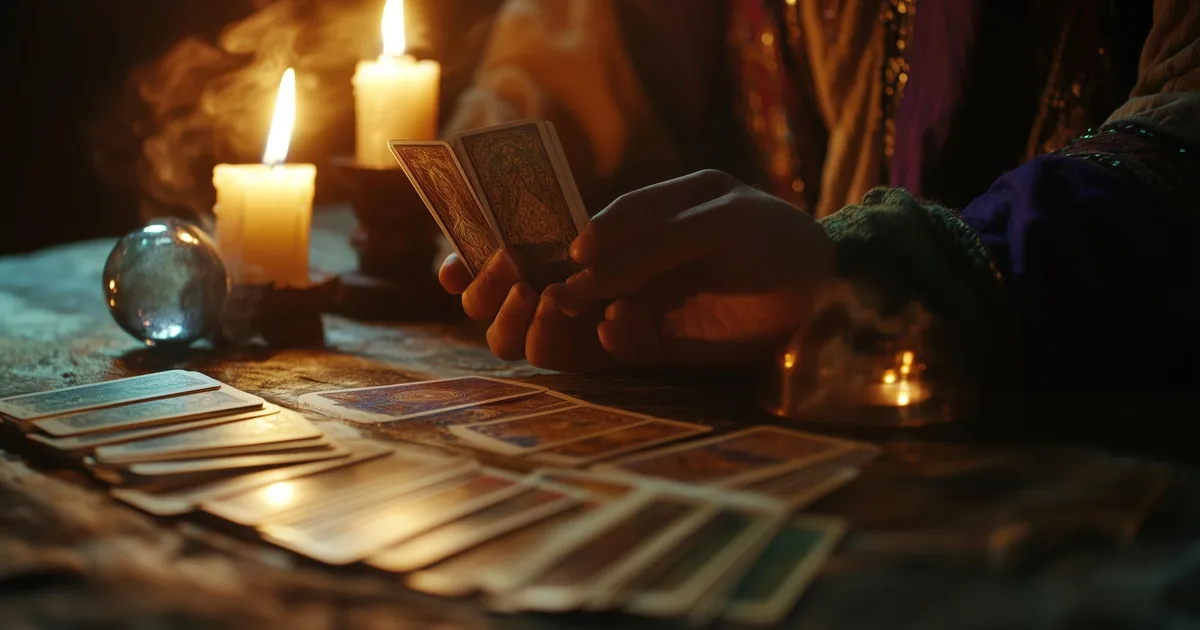
In the Tarot tradition, a spread is not just "laying out cards." It is a way to structure chaos. When you ask a question and lay out the cards according to a specific scheme, you create a map of the situation. The more precise the scheme, the clearer the answer. Therefore, new tarot spreads often appear where old ones stop working: in topics of self-esteem, choosing a path, relationships with oneself, and not just with a partner.
At EXETERIC, we have observed for years how readers search for "tarot spread online new" or "new free tarot spreads," hoping to find a magic pill. But the magic is not in the scheme. It is in your intention and your ability to listen. However, structure helps. Especially when you are just starting out. That is why we have gathered 7 schemes—from simple to deep. They will not replace the classics, but they will open new facets.
Important: new tarot spreads do not cancel ethics. We do not divine on someone else's will, do not ask "when will he return," and do not try to predict death. We work with energy, symbols, and the subconscious. If you are looking for exactly this approach—you are in the right place. And if you want to delve deeper into the symbolism of the cards, take a look at other practices in the EXETERIC blog.
How to Read New Tarot Spreads: 3 Rules That Will Save You Years
Before we move on to the schemes, let's agree on the basics. Without them, even the most genius spread will turn into a set of random pictures. Here are three rules we have derived from practice.
Rule 1: The question is more important than the scheme. If you ask "what awaits me?", the cards will answer with fog. If you ask "what is my next step in my relationship with myself?"—the answer will be specific. New tarot spreads often require narrower formulations than classic ones. This is not a minus, but a plus: you learn to think more precisely.
Rule 2: The card's position is not a verdict, but a point of view. When you lay out cards in a new spread, each position is not "what will happen," but "how to look at it." For example, the "shadow" position does not mean a catastrophe awaits you. It means: look here, a resource or a lesson is hidden here.
Rule 3: Intuition does not cancel the system, but complements it. Many search for "tarot for help new spreads" or "tarot with nina new spreads watch," hoping that someone else will do the work for them. But even if you watch someone else's spread, you gather the final meaning yourself. The cards are a language. You are the translator.
And one more thing: don't be afraid of simple schemes. Sometimes one card for a question gives more than ten positions. Depth is not in the number of cards, but in the honesty of the question.
| Common Myth | Why It's Not So | How It Really Is |
|---|---|---|
| "New spreads are necessarily complicated" | Complexity does not equal precision. Many new schemes are created for quick daily checks. | Simple spreads of 1–3 cards often give a clearer answer than cumbersome ones. |
| "If a spread is new, it's automatically better" | Novelty is not a guarantee of quality. The structure and logic of the positions matter. | A working spread is one you understand and can repeat. |
| "Tarot today's spread new can be watched for free and without preparation" | Free access does not cancel the need to think and feel. | Even a ready-made spread requires your interpretation and engagement. |
Scheme 1: "One Question — One Card" (for those in a hurry)
Let's start with the simplest. This is not exactly a "new" spread, but in a modern format, it has taken on a new life. You ask one clear question and draw one card. That's it. No "what ifs," no additional positions. This method is ideal for the morning: "What energy will support me today?" or "What should I pay attention to in the conversation with my boss?"
Why does it work? Because one card doesn't let you diffuse your attention. It demands specificity from you. If the Hierophant comes up—not "well, probably something spiritual," but "today I rely on tradition, on a rule, on a proven method." If the Eight of Swords comes up—"today I might feel trapped, but it's an illusion, and I can choose a different perspective."
Many searches for "tarot new spread for today" or "tarot new spreads today free" are exactly about this need: fast, clear, without extras. And that's normal. Not every day requires deep psychoanalysis. Sometimes one symbol is enough to set the tone.
Practical step: make a habit of drawing one card in the morning and writing it down in your notes. In the evening, check in. In a month, you will see patterns—and this will be your personal dialogue with the deck, not someone else's interpretations.
Scheme 2: "Three Cards: Past — Present — Future" in a New Reading
The classic trio. But new tarot spreads offer to reinterpret it. Instead of linear time, we look at energy: "What holds me back?", "What drives me forward?", "Where am I heading if I change nothing?" This is no longer divination, but diagnostics.
Why is this important? Because the linear "past-present-future" often leads to fatalism: "well, the future is bad, nothing can be done." But the energetic trio returns authorship to you. You see that the "future" is not a verdict, but a vector. And it can be changed if you change what holds you back.
A practical example: a client asked about work. The cards drawn were: Five of Pentacles (holds back—feeling of lack), Ace of Wands (drives forward—desire to start one's own), The Tower (vector—sharp change). In a classic reading, The Tower in the future is a catastrophe. In a new reading, it's a signal: if you don't start your own thing, external circumstances will still pull the rug out from under you. And that's not scary, but honest.
This approach is used by many practitioners when they search for "tarot for help new spreads today" or "tarot for help tatyana new spreads." The essence is the same: the cards do not predict, but show energy. You are the one who decides how to direct it.
Practical step: lay out three cards. Ask the first: "What holds me back?" The second: "What drives me forward?" The third: "Where does the current course lead?" Write it down. In a week, review it. You will be surprised how much has changed just from awareness.
Scheme 3: "Wheel of Balance" — 6 Life Spheres on Cards
This spread is good for those who feel that "everything seems fine, but something is wrong." You lay out six cards in a circle or in a line, each representing a sphere: body, mind, emotions, relationships, work, spirit. And you see where energy flows and where there is stagnation.
New tarot spreads often suffer from being overloaded, but the "Wheel of Balance" is an exception. It is simple and visual. You immediately see which sphere is "screaming." For example, in the "work" sphere, The Hermit comes up—perhaps you need solitude for work, not team meetings. In the "relationships" sphere—Four of Cups: you are satiated or closed off. This is not a diagnosis, but an invitation to reflect.
Why does this work from an esoteric perspective? Because a person is a system. If one sphere is in deficit, it draws energy from others. The cards show where the leak is. And this is much more useful than asking "when will I meet love."
Many readers search for "cosmo tarot new spreads" or "witch tarot new spreads," hoping to find ready-made answers. But the "Wheel of Balance" is a tool you can use yourself. No subscription, no waiting for an issue. Just a deck and honesty.
Practical step: do this spread once a month. Photograph it. Compare. You will see how the energy in the spheres changes. This is real magic—not prediction, but conscious observation.
Scheme 4: "Shadow and Light" — for Working with Inner Conflicts
This spread is for those ready to look into the shadow. It consists of four cards: "The Light Side of the Situation," "The Shadow Side," "What I Don't Want to See," "Resource for Integration." It's not for the faint of heart, but it is incredibly healing.
In esotericism, the shadow is not "bad." It is what we have repressed: fear, anger, shame, desire. New tarot spreads increasingly include shadow positions, because without them any prediction becomes superficial. You can ask "what awaits me" as much as you want, but if you don't see your shadow, you will keep stepping on the same rake.
Example: a client asked about business. The cards drawn were: The Sun (light), The Devil (shadow), The Moon (what one doesn't want to see), The Star (resource). In the classic reading, The Devil is addiction, manipulation. In shadow work, it could be the fear of success that he hides behind procrastination. The Moon—the illusion that "everything will sort itself out." The Star—hope and clarity that will come if you acknowledge the shadow.
This approach is used in deep practices, sometimes called "tarot zen new spreads" or "new tarot spreads in zen." Zen here is not about Buddhism, but about acceptance. You don't fight the shadow; you see it. And that changes everything.
Practical step: take four cards. The first—"what I show the world." The second—"what I hide." The third—"what I don't want to admit." The fourth—"what resource will help me integrate this." Write it down. Don't try to solve it immediately. Just observe.
| Situation | Reactive Approach | Conscious Practice | Result |
|---|---|---|---|
| A frightening card comes up (The Tower, The Devil, Ten of Swords) | Panic, searching for the "scary" meaning, desire to reshuffle | Ask: "What lesson or resource is hidden here?" | Reduced anxiety, clarity, sense of control |
| The spread doesn't "match" reality | Blaming the cards, yourself, or the "wrong deck" | Check the question's formulation and your own honesty | A more precise question—a more precise answer |
| Wanting to watch others' spreads instead of your own | Endlessly searching for "tarot with nina new spreads watch" | Do your own simple spread with 1 card | Growth of trust in yourself and your intuition |
Scheme 5: "Path Map" — 7 Cards for Major Decisions
When you need to make a big decision—change jobs, move, start or end a relationship—simple spreads don't suffice. Here you need the "Path Map." It is 7 cards laid out in a line. Each represents a stage: "Where I Am Now," "What Hinders Me," "What Helps Me," "Hidden Resource," "The Price of the Decision," "The First Step," "Where I Will Arrive."
Why 7? Because it is a number of completion in many traditions. But the main thing is the structure. You are not just looking at "what will be," you are seeing the process. This removes the fear of the unknown. New tarot spreads are often criticized for "clutter," but here every position is justified.
Example: a client was deciding whether to leave her job. The cards drawn were: Eight of Pentacles (now—routine, but mastery), Five of Swords (hinders—conflicts), Three of Wands (helps—vision of prospects), Temperance (resource—patience and balance), Ten of Swords (price—painful ending), Page of Cups (first step—acknowledge your feelings), The World (where you will arrive—completion and a new cycle). The spread didn't say "leave" or "stay." It showed that leaving would be painful but would lead to the completion of a cycle. The decision remained with her.
Many search for "tarot spread new tatyana" or "tatyana tarot spreads new today," hoping that someone else will make the decision. But the "Path Map" is a tool for independent choice. You are not shifting responsibility to the cards. You are using them as a compass.
Practical step: before the spread, formulate the decision you are making. Then lay out 7 cards. Write everything down. Return to the notes in a month. You will see how the spread helped you see what you hadn't noticed.
Scheme 6: "Mirror of Relationships" — 5 Cards for Couples and Not Only
This spread is not about "loves/doesn't love." It's about dynamics. 5 cards: "Me in the Relationship," "Partner in the Relationship," "What Is Between Us," "What Connects Us," "What Separates Us." It works for romantic couples, friendships, and work relationships alike.
Why is this a new approach? Because classic relationship spreads often ask "what does he feel?"—and this puts you in the position of an observer. The "Mirror," however, returns you to the system. You see yourself, your partner, and the field between you. This is more honest.
Example: a couple on the verge of divorce. The cards drawn were: The Empress (me—care, but also control), Knight of Swords (partner—sharpness, haste), Two of Cups (between us—there is still a connection), Four of Pentacles (connects—fear of losing stability), Five of Wands (separates—competition). The spread showed that the connection exists, but it is being suffocated by fear and a struggle for power. This is not a verdict, but a point of growth.
This spread is often used in the practice called "tarot for help new spreads" or "tarot for help new spreads today." The essence is to help, not to judge. And that is important.
Practical step: if you are doing a relationship spread, don't ask "what does he think." Ask "what do I bring into these relationships?" and "what do I not see?" This changes everything.
Scheme 7: "Advice from the Higher Self" — 4 Cards for Deep Connection
This is the deepest spread in our collection. It's not about events. It's about connection with yourself. 4 cards: "What Does My Higher Self Want Me to Know?", "What Prevents Me from Hearing It?", "What Is the First Step?", "What Energy Will Support Me?" This spread is not for daily use. It's for moments when you feel you've lost your bearings.
In esotericism, the Higher Self is not a "guardian angel" or a "spirit guide." It is your most whole part, which sees the big picture. By addressing it through the cards, you tune into your deep intuition. New tarot spreads increasingly include such positions because people are tired of superficial predictions. They want connection.
Example: a client in crisis. The cards drawn were: The Star (message—hope and clarity), Eight of Cups (hinders—attachment to the past), Knight of Pentacles (step—slow but specific), The Sun (support—joy and life force). The spread didn't say "everything will be fine." It said: "You can find clarity if you let go of the past and take one small step." This is not divination. This is a guide to action.
Many search for "tarot new today watch spread" or "tarot new spreads new releases," hoping that someone will give them this advice. But true advice comes from within. The cards are merely a mirror. If you want to delve deeper into your archetypes, take a look at the analysis of the arcana—there we speak the same language, but through numbers.
Practical step: do this spread no more than once a month. Write it down. Return to the notes. You will see how your Higher Self speaks to you through symbols. This is the real magic of Tarot—not prediction, but dialogue.
And finally: it doesn't matter which spread you choose. What matters is the intention with which you do it. If you search for "new tarot spreads" out of curiosity—you will get curiosity. If for self-knowledge—you will get yourself. The choice is yours.
Tarot as a Mirror, Not a Crystal Ball: What Remains After the Spread
We have gone through seven schemes—from one card to a deep dialogue with the Higher Self. But if you remember only one thought from this article, let it be this: Tarot does not predict the future, it shows you yourself. Every spread is not a verdict or a magic pill, but a way to hear yourself a little more clearly. The cards do not decide for you, do not cancel your will, and do not carry a threat. They merely illuminate what you already know but are afraid to admit. And in this lies their true power.
Esotericism is not about fear at all. It is about awareness. About living not on autopilot, but with attention to your states, choices, and energy. New Tarot Spreads are tools that help you slow down, ask an honest question, and hear the answer. Not because the cards "speak," but because you finally fall silent and listen. If this approach resonates with you—without mystical fog, but with respect for symbols—it will be helpful to look into the EXETERIC practice, where we gather calm and deep materials on self-knowledge.
Start small. Don't try to master seven cards at once if you haven't yet befriended one. Draw a card in the morning, write down a thought, check in in the evening. In a week, you will notice you've become more attentive to yourself. In a month—that your questions have become more precise. In a year—that you have changed. This is real magic: not prediction, but a dialogue that changes the one who engages in it.
If you want to broaden your perspective—look at the astrology section to see your situation through the lens of your zodiac sign. Or take a look at other practices in the EXETERIC blog—there we analyze archetypes, numbers, symbols, and how all of this connects to everyday life. Esotericism is not about "believing or not believing." It's about living consciously, with respect for yourself and the world. Don't fear the unknown—understand it calmly. Try one scheme. One card. One honest question. And allow yourself to hear the answer.
Frequently Asked Questions
How many cards are needed for a new spread to be accurate?
The number of cards does not determine accuracy. One card for a clear question often gives more clarity than ten positions in a cumbersome scheme. Accuracy depends on the formulation of the question, your state, and your readiness to hear the answer. If you are in a hurry or distracted, even a large spread will turn into a set of random pictures. Start small: one card in the morning, three cards for a situation, and only then move on to deep schemes. This way, you will gradually learn to trust your perception, not the number of cards laid out.
Can you do new tarot spreads for another person without their consent?
Technically, yes, but ethically, it's not advisable. Spreads on someone else's will, feelings, or decisions violate boundaries and turn Tarot into a tool of control. It is much more honest to ask: "What do I bring into these relationships?", "What do I not see?", "How can I act ecologically?" Such questions return authorship to you and do not place the other person in the position of an object. If you want to help a loved one, it is better to offer them to do a simple spread themselves or to discuss the situation together without cards. Respect for another's freedom is the foundation of any spiritual practice.
What to do if a frightening card comes up—The Tower, The Devil, Ten of Swords?
First of all—do not panic and do not reshuffle the deck. In new tarot spreads, such cards often do not mean a catastrophe, but a point of growth. The Tower is a sharp liberation from the old, The Devil is an addiction or fear that it's time to see, Ten of Swords is the completion of a painful cycle. Ask yourself: "What lesson or resource is hidden here?", "What can I change?" Write down the thought and return to it in a day. Often, it is these cards that give the most honest and healing answer if you look at them without fear.
How often can you do deep spreads like "Advice from the Higher Self"?
Deep spreads are not for daily use. They require silence, honesty, and time for reflection. The optimal frequency is once a month or in moments when you feel you've lost your bearings. If you do them every day, you will stop hearing the answer because you won't have time to live it. It's better to draw one card in the morning and write down a thought, and once a week do a trio for a situation. Depth is not in frequency, but in the quality of attention. Give yourself time to hear what the cards are saying, and don't rush events.