Rider-Waite Tarot: Why This Particular Deck Is the Best First One
Why the Rider-Waite Tarot Became the Gold Standard
When it comes to tarot cards, even those who have never held a deck in their hands most often picture the imagery of the Rider-Waite deck. This deck, created in 1909 by Arthur Edward Waite and artist Pamela Colman Smith, has remained the most popular and recognizable for over a century. But why is it considered the best first deck? The answer lies not only in aesthetics but also in the deep thoughtfulness of its symbolism.
The Rider-Waite Tarot is not just a set of pictures. Each arcana is a whole story encoded in details. Waite, being a member of the Hermetic Order of the Golden Dawn, embedded numerous esoteric symbols into the illustrations, from Kabbalistic correspondences to alchemical signs. But his main innovation was the illustration of the minor arcana. Before Waite, the minor arcana were often depicted schematically: just the suit and the number of symbols. Waite and Smith created full narrative scenes that themselves hint at the meaning. This makes the deck ideal for beginners: even without knowing the meanings, you can intuitively read the sense from the image.
Moreover, the classic Rider-Waite Tarot has become the foundation for most modern decks. Having studied it, you will easily be able to work with any others — from the Marseille Tarot to fantasy and minimalist ones. It is a kind of universal language spoken by all tarot readers in the world.
But let us look more closely: what exactly makes the Rider-Waite Tarot so special? And why do psychologists and esotericists recommend starting with it? The answers lie in the structure of the deck, its symbolism, and its practicality.
Deck Structure: Rider-Waite Tarot Arcana
The Rider-Waite Tarot deck consists of 78 cards, which are divided into two large groups: the Major Arcana (22 cards) and the Minor Arcana (56 cards). The Major Arcana describe the main life stages and archetypal situations — from The Fool to The World. The Minor Arcana, in turn, are divided into four suits: wands, cups, swords, and pentacles. Each suit corresponds to one of the elements and a sphere of life.
Here is how the suits are distributed in the Rider-Waite Tarot:
| Suit | Element | Sphere of Life | Example Cards |
|---|---|---|---|
| Wands | Fire | Action, creativity, passion, career | Ace of Wands, Knight of Wands |
| Cups | Water | Emotions, relationships, intuition | Ace of Cups, Ten of Cups |
| Swords | Air | Thoughts, conflicts, communication | Ace of Swords, Eight of Swords |
| Pentacles | Earth | Money, work, material matters | Ace of Pentacles, Ten of Pentacles |
Each suit contains 14 cards: an ace, cards from two to ten, and four court cards — page, knight, queen, and king. Court cards symbolize people or aspects of personality. For example, the Queen of Cups is an emotional, caring woman, while the Knight of Swords is a quick, sharp-tongued person.
This structure allows for spreads on any topic, from love to career. But the main thing is that in the Rider-Waite Tarot, each arcana has a clear meaning that is easy to remember thanks to the image. For example, the Eight of Swords depicts a bound and blindfolded woman surrounded by swords. It is immediately clear: this is a feeling of a trap, of limitations, but the swords are not stuck into the ground — there is a path to liberation. Such visual cues make the Rider-Waite Tarot for beginners an ideal tool.
Symbolism and Meaning of the Rider-Waite Tarot
The Rider-Waite Tarot meaning is not just a set of memorized phrases. Every symbol on the card has a meaning that can be interpreted on different levels. Take, for example, the Major Arcana The Lovers. The card depicts Adam and Eve in the Garden of Eden, with the angel Raphael above them. Traditionally, this is a card of choice, love, and harmony. But if you dig deeper, The Lovers symbolize the union of opposites, inner wholeness, and the need to make decisions by following the heart, not just the mind.
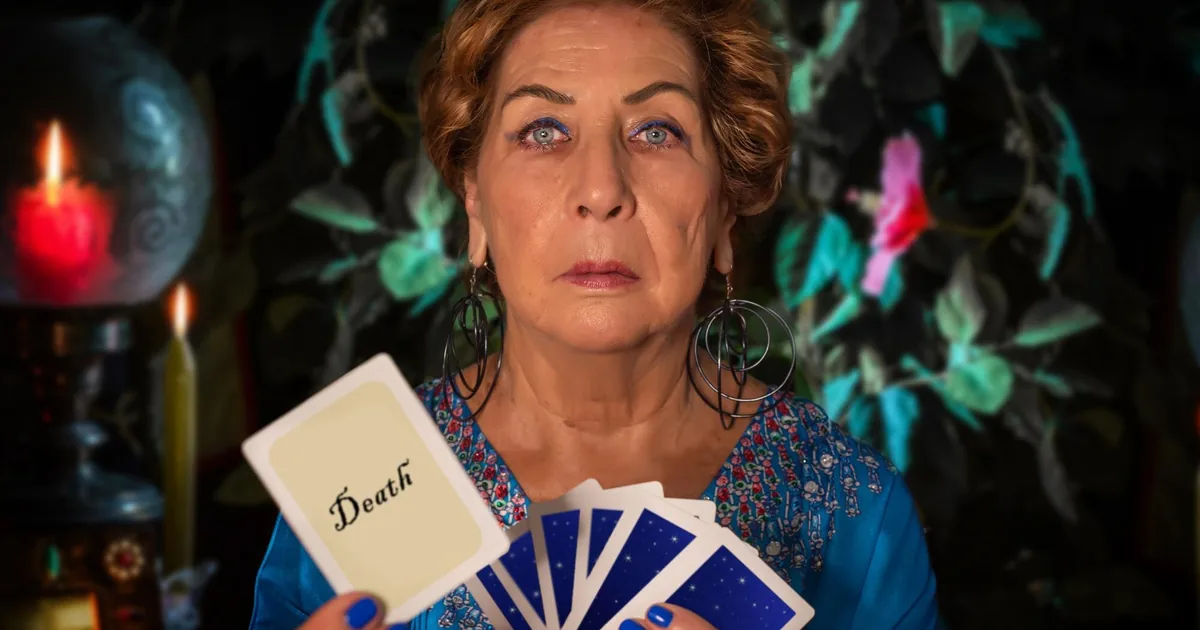
Or take Death — a card that frightens beginners. It depicts a skeleton in armor trampling a king, with a child, a woman, and a priest nearby. Death in the Rider-Waite Tarot rarely means physical death. It is a symbol of transformation, the end of one stage and the beginning of another. The skeleton is what remains after everything superficial falls away. Therefore, in spreads, Death often indicates the need to let go of the old to make room for the new.
The table below shows how the same symbols can manifest in life:
| Symbol / Image | Traditional Meaning | Manifestation in Life | What to Do |
|---|---|---|---|
| The Fool (Major Arcana) | The beginning of a journey, spontaneity, faith in the best | Changing jobs, moving, a new hobby | Trust your intuition, but do not forget about preparation |
| Ten of Swords | Crisis, ending, but also hope for dawn | Breakup, layoff, illness | Acknowledge the pain, but remember: a new day is coming |
| Ace of Pentacles | A material opportunity, prosperity | A new job, a lucrative offer, profit | Act practically, lay the foundation |
Understanding the symbolism helps not only to memorize meanings but also to feel the cards. When you look at a card, ask yourself: "What feelings does it evoke in me? What associations come to mind?" This develops intuition, which in tarot is no less important than knowledge of traditional interpretations.
How to Work with the Rider-Waite Tarot: First Steps
So, you have decided to begin your journey with the Rider-Waite Tarot. Where to start? The first thing is to get acquainted with the deck. Do not rush into complex spreads right away. Take the cards in your hands, examine each one. Feel their energy. You can even sleep with the deck under your pillow for a few nights to establish a connection.
The second step is studying the meanings. For beginners, it is best to start with the Major Arcana. There are only 22 of them, and they describe the main life scenarios. Learn their meanings, but not mechanically — through stories. For example, The Chariot is victory through control and will. The Empress is abundance, motherhood, creativity. The Hermit is the search for truth, solitude.
Once the Major Arcana become clear, move on to the Minor Arcana. Here, knowledge of suits and numbers will help. For example, all Aces mean new beginnings in the corresponding sphere: Ace of Wands — a creative impulse, Ace of Cups — new feelings, Ace of Swords — clarity of thought, Ace of Pentacles — a material opportunity.
For daily practice, you can use a simple one-card "Card of the Day" spread. In the morning, draw a card and think about how its energy might manifest during the day. In the evening, analyze what happened. This will help you better understand the cards and their connection to reality.
It is also useful to keep a tarot journal. Write down your spreads, interpretations, and results. Over time, you will notice that your intuition strengthens and the meanings of the cards become deeper.
Rider-Waite Tarot Spreads for Beginners
Once you have mastered the basic meanings, you can move on to spreads. For beginners, simple layouts that do not overload with information are best. Here are a few popular Rider-Waite Tarot spreads:
- One card — a quick answer to the question "What do I need to know today?" or advice for the day.
- Three cards — the "Past-Present-Future" spread or "Situation-Action-Result." It helps to see the dynamics.
- Celtic Cross — a more complex 10-card spread that gives a full picture of the situation. But it is better to master it after some practice.
It is important to remember: tarot does not predict fatally. It shows probabilities and tendencies that can change depending on your actions. Therefore, when asking questions to Rider-Waite tarot cards, formulate them openly: "What do I need to know about...?", "How can I improve...?" Instead of "When will I meet my love?" ask "What can I do to attract love?"
When performing a spread, try to relax and turn off your inner critic. Look at the cards, note your first impressions. Then compare them with traditional meanings. Over time, you will learn to combine both approaches.
Rider-Waite Tarot: Reversed Cards and Combinations
Many tarot readers use reversed cards to gain additional shades of meaning. In the Rider-Waite Tarot, a reversed card can indicate blocked energy, an inner conflict, or a delay. For example, the reversed Empress may speak of a creative crisis or issues with self-esteem. However, beginners do not necessarily need to use reversed meanings right away. Start with upright cards, and when you feel confident, try adding reversed ones.
Rider-Waite Tarot combinations are a separate art. Cards in a spread influence each other, creating unique meanings. For example, if the Ace of Pentacles lies next to The Devil, this may indicate material dependency or an obsession with money. If The Devil is combined with The Star, it suggests that a person is freeing themselves from bad habits and finding hope.
To begin with, you can use simple combinations: pay attention to the suit and number of neighboring cards. For example, several swords in a spread indicate a conflict situation, while many cups indicate emotional involvement. Remember that interpretation always depends on the question and context.
The Rider-Waite Tarot Book and Other Resources
To deepen your knowledge, it is worth turning to primary sources. Arthur Waite wrote the book "The Pictorial Key to the Tarot," where he explained in detail the meaning of each card. This is not just a reference book but a philosophical work that will help you understand the creator's intent. It is also useful to study the works of other authors, such as Mary Greer or Rachel Pollack, who offer modern approaches to interpretation.
On the internet, you can find many resources, including articles and video tutorials. But be careful: not all sources are equally reliable. Try to choose authors who respect tradition and do not promise instant miracles. Tarot is a tool for self-discovery, not a magic wand.
If you want to expand your knowledge of other esoteric practices, check out the articles on magic and self-discovery on EXETERIC. There you will find materials on astrology, dreams, and other directions that will help you better understand yourself and the world around you.
Common Mistakes of Beginners in the Rider-Waite Tarot
Beginning tarot readers often make the same mistakes. One of them is trying to memorize all the meanings by heart without feeling the cards. This leads to mechanical interpretation that does not account for nuances. Instead, try to live through the card anew each time, asking yourself: "How does this card resonate within me?"
Another mistake is the fear of "negative" cards. There are no bad cards, only complex energies. Even The Tower, which often frightens, can mean liberation from illusions. Perceive such cards as a challenge and an opportunity for growth.
Beginners also often ask the cards the same questions multiple times, hoping for a different answer. This does not work: tarot shows the current situation, and if you do not change your actions, the answer will be the same. Better to ask a different question or take a break.
And finally, do not rely on tarot to make decisions instead of yourself. The cards are an advisor, but the final choice is always yours. Use tarot as a tool for reflection, not as an oracle that decides for you.
Practice: Daily Work with the Rider-Waite Tarot
To truly master the Rider-Wite Tarot, regular practice is needed. Start with a simple ritual: draw one card every day and reflect on it. This can be in the morning, before the start of the day, or in the evening, summing up. Write down your thoughts in a journal.
After a month, you will notice that the cards have become closer to you and their meanings deeper. You will begin to notice recurring symbols and themes in your life. This is the magic of tarot — it helps to see patterns and make conscious choices.
When you feel confident, try doing spreads for friends. This will help you hone your skills and get feedback. But remember about ethics: do not predict events that might frighten a person, and do not invade personal boundaries. Tarot is a tool for help, not for manipulation.
If you want to delve into other practices, such as astrology, check out the astrology section on EXETERIC. And for those interested in dreams, we have prepared the EXETERIC dream book, where you can find interpretations of the most common dreams.

Tarot as a Mirror of the Soul: Your Path to Yourself
When you hold the Rider-Waite deck in your hands, you hold not just a tool for predictions. It is a key to understanding your own thoughts, feelings, and hidden motives. The Rider-Waite Tarot becomes a faithful companion on the path of self-discovery, helping you ask the right questions and find answers within yourself. It does not give ready-made solutions but illuminates the road, allowing you to see new perspectives and opportunities.
It is important to remember: esotericism is not a magic pill or a way to avoid responsibility. It is a language of symbols that helps us better understand ourselves and the world around us. Tarot does not predict fatally — it shows probabilities that we can change with our actions. Therefore, do not fear complex cards or tangled situations. Perceive them as an invitation to reflection, as an opportunity to look deep within yourself and find hidden resources.
Start small: draw a card of the day, keep a journal, observe how the energies of the arcana manifest in your life. Over time, you will notice that you become more conscious, learn to trust your intuition, and make balanced decisions. EXETERIC practices will help you in this, offering a structured approach to studying esotericism and self-discovery.
If you want to delve into other topics, check out the astrology section — perhaps your zodiac sign will hint at which practices suit you best. And in the EXETERIC blog, you will find many articles about magic, dreams, and spiritual development that will expand your understanding of the world.
Remember: tarot is a tool, not a goal. Do not let the cards control your life; use them as an advisor that helps you hear your own inner voice. Be open to the new, but maintain critical thinking. And then the Rider-Waite Tarot will become for you not just a deck, but a faithful friend and wise mentor on the path to harmony and self-discovery.
Take the first step today — pick up the cards and let them tell your story. Do not fear the unknown: examine it calmly, with respect for tradition and for yourself. And may every spread bring you closer to understanding yourself and your place in this world.
Frequently Asked Questions
How is the Rider-Waite Tarot different from other decks?
The Rider-Waite Tarot differs in that all 78 cards are illustrated, including the minor arcana. This allows beginners to intuitively understand the meanings of the cards without memorizing them mechanically. In addition, the symbolism of the deck is based on deep esoteric traditions, such as Kabbalah and alchemy, which makes it multi-layered and suitable for study at different levels. Most modern decks are created based on the Rider-Waite system, so once you master it, you will easily be able to work with other systems.
Can the Rider-Waite Tarot be used for predictions?
Yes, the Rider-Waite Tarot can be used for predictions, but it is important to understand that the cards do not show a fatal future. They reflect current tendencies and probabilities that can change depending on your actions. Tarot helps to see possible scenarios of how events might unfold and suggests how best to act in a given situation. Many tarot readers use the Rider-Waite deck specifically for predictive practices, combining traditional meanings with intuitive reading.
How quickly can one learn to read the Rider-Waite Tarot?
The speed of learning depends on the regularity of your practice and engagement. Some begin to feel the cards within a few weeks of daily exercises; others need several months. The main thing is not to rush and not to try to learn all the meanings at once. Start with the Major Arcana, then move to the Minor Arcana, use simple spreads, and keep an observation journal. Over time, you will notice that your intuition strengthens and your interpretations become deeper and more accurate.
Do you need special abilities to work with the Rider-Waite Tarot?
No, special psychic abilities are not needed to work with the Rider-Waite Tarot. Tarot is a tool accessible to anyone willing to learn and practice. The main thing is to develop observation, intuition, and the ability to interpret symbols. Many people successfully use tarot for self-discovery and meditation without being professional fortune-tellers. It is important to approach the practice with respect and an open mind, and then the cards will reveal their secrets to you.