Tarot cards: a complete guide for beginners
What Are Tarot Cards and Why Do You Need Them
Tarot cards spread. Let's be honest: tarot cards are not a magic wand that will show you when you'll get married or get a promotion. They are more like a mirror that helps you look at a situation from a different angle, see hidden motives and possible scenarios for how events might unfold. In the hands of a conscious person, tarot becomes a powerful tool for dialogue with intuition and the subconscious. This is not fortune-telling over coffee grounds, but a structured system of symbols that helps you navigate complex life collisions.
Imagine you are stuck in a labyrinth. You can wander through the corridors, hitting dead ends, or you can climb up to an observation deck and see the labyrinth from above. Tarot cards are that observation deck. They do not give ready-made answers, but they show the direction, point out obstacles, and help you realize what resources you already have. This is a practice of mindfulness that requires honesty with yourself and a willingness to face the truth, even if it is not quite what you expected to see.
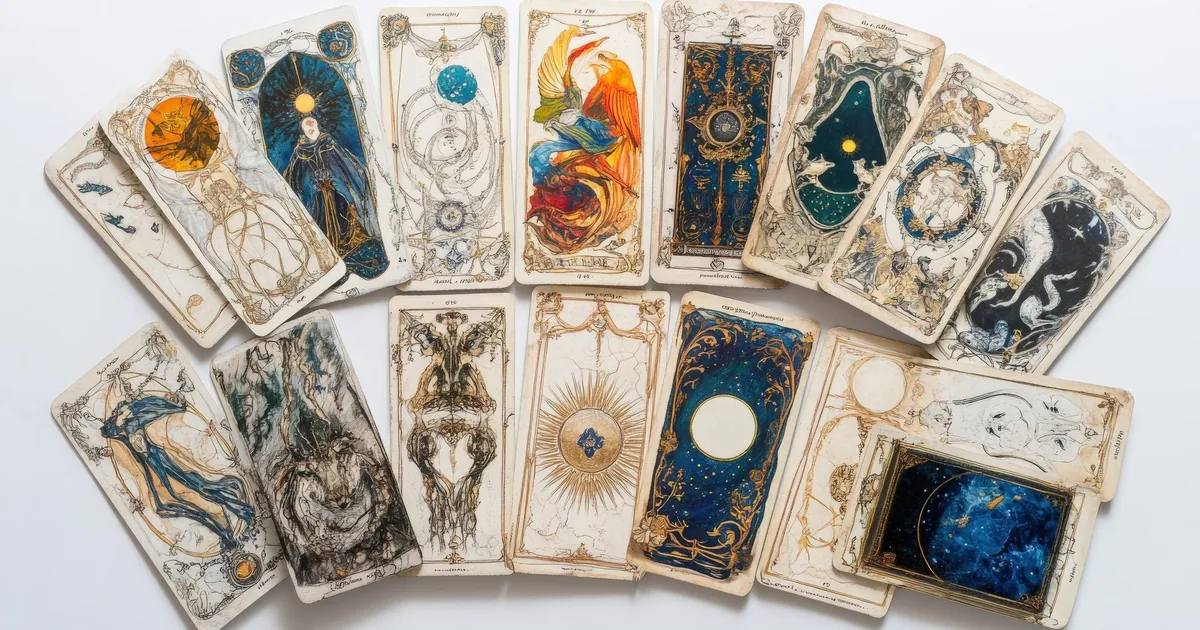
For those who are just beginning their path in esoterics, it is important to understand: tarot is not a replacement for common sense and not a reason to panic. It is a way to expand perception and gain access to information that is often hidden beneath the surface of everyday events. When you do a spread, you are, in a sense, asking the universe a question, and the cards answer in the language of symbols. Your task is to learn how to translate these symbols into the language of your own life. And that is exactly what we will teach you in this guide.
How the Deck Is Structured: Major and Minor Arcana
A full tarot deck consists of 78 cards, divided into two main groups: the Major Arcana (22 cards) and the Minor Arcana (56 cards). The Major Arcana are like the main characters of your life story. Each of them symbolizes a specific archetype, lesson, or stage of the spiritual path. Starting with the Fool (number 0) and ending with the World (number 21), they describe the soul's journey from innocence to wisdom, through trials and transformations. Tarot cards major arcana are the core of the deck, its foundation. When a Major Arcana card appears in a spread, it is a signal that you are facing not just an everyday situation, but something deeper, connected to your inner growth.
The Minor Arcana are divided into four suits, each reflecting a specific sphere of life. They are like the four elements, four aspects of our existence. Swords are the realm of the mind, intellect, conflicts, and truths. They speak of thoughts, decisions, communication, and sometimes the pain that brings clarity. Cups are the world of emotions, feelings, relationships, and intuition. They reflect our desires, dreams, joys, and disappointments. Wands are the energy of action, creativity, passion, and career. They symbolize movement, projects, and our ability to exert will in the world. Pentacles are the material world: finances, health, work, home, and everything that can be touched with your hands. Each suit is like a separate book, and together they form a complete encyclopedia of human experience.
Within each suit, there are cards from Ace to Ten (numbered cards) and four Court cards: Page, Knight, Queen, and King. The numbered cards describe the development of a situation from its inception (Ace) to its completion (Ten). The Court cards are characters who act within that situation: from the inexperienced student (Page) to the mature master (King). Understanding this structure is the first step toward competent interpretation. When you see, for example, the Page of Swords, you understand that this is the energy of a young, curious mind that is just beginning to explore new information.
How to Start Correctly: Choosing a Deck and First Steps
Choosing a deck is a personal journey. There is no "best" deck for everyone. There is a deck that resonates specifically with you. For beginners, the classic Rider-Waite deck (Rider-Waite-Smith) is often recommended. Its cards are filled with clear, allegorical imagery that is easy to interpret. It is like a textbook with vivid illustrations: every symbol has meaning, and it is not difficult to decipher. Other popular options are the Thoth deck (Aleister Crowley) or the Marseille Tarot, but they require a deeper understanding of symbols and can be challenging for a novice.
Before you begin doing spreads, it is important to create the right space and mindset. This is not just a formality, but a way to show yourself and the cards that you are approaching the matter seriously. Choose a quiet place where you will not be distracted. You can light a candle or place a stone you like nearby — this helps create an atmosphere of focus. Before drawing cards, sit comfortably, close your eyes, and take a few deep breaths. Focus on your question. The question should be clear and open-ended. Do not ask "yes or no," but rather ask "what should I know about...", "what energies are influencing...", "how can I best act in this situation...".
The first spread for beginners should be simple. Do not try to tackle a complex ten-card layout right away. Start with one card — this is the so-called "card of the day." Every morning, draw one card and observe throughout the day how its energy manifests in your life. This teaches you to notice symbols and connect them to real events. Write down your observations in a notebook. Over time, you will notice patterns and understand how the cards "speak" to you. Remember that tarot is a skill that develops with practice. Do not expect to see all layers of meaning from the first try. Be patient with yourself and with the process.
How to Read Cards: Meaning and Interpretation
Interpreting cards is an art that combines knowledge of traditional meanings with developed intuition. Each card has a basic meaning, but it can change depending on the context of the spread, the position of the card, and its interaction with other cards. For example, the Death card (XIII Major Arcana) does not mean physical demise. It is a symbol of transformation, the end of one stage and the beginning of another. It speaks of the need to let go of the old to make room for the new. But if this card appears in a position related to the past, it may mean that you have already gone through deep changes that shaped your present.
When interpreting, it is important to consider the upright and reversed position of the card. A reversed card (upside down) does not necessarily mean something bad. It can be blocked energy, an internal aspect, or a slowing down of the process. For example, the reversed King of Cups may speak of a person who suppresses their emotions or of a situation where feelings cannot find an outlet. To understand how a reversed meaning works, ask yourself: "What is preventing this energy from manifesting fully?" or "How does this energy manifest inside me, rather than in the outer world?"
One of the most common mistakes beginners make is literal interpretation. Tarot cards speak in the language of metaphors and symbols. You should not perceive every detail of the image as a direct instruction. If the card depicts a person falling from a cliff (the Tower), it does not mean you will fall off a roof. It is a symbol of the sudden destruction of illusions, the collapse of an old structure that no longer serves you. To learn how to read symbols, it is useful to keep a tarot journal. Write down each card, your first impressions, and then how the situation developed in reality. Over time, you will develop your own personal dictionary of symbols that works specifically for you.
Common Mistakes and How to Avoid Them
One of the most common mistakes is dependence on tarot. A person starts asking the cards about everything: whether to drink coffee, whether to reply to a message, whether to go to work. This is not practice, but an escape from responsibility for one's own decisions. Tarot is a tool for gaining perspective, not a replacement for your own will. If you find that you cannot make a single decision without a spread, that is a signal to stop and work on trusting yourself. A healthy practice means using tarot to reflect on complex situations, not for the trivialities of daily life.
Another mistake is negative programming. If you see a card that is traditionally considered "difficult" (for example, the Ten of Swords or the Five of Cups) and immediately decide that disaster awaits you, you are creating a negative scenario. Cards show potential, not inevitability. The Ten of Swords can speak of a painful ending that clears the way for a new beginning. The Five of Cups speaks of the bitterness of loss, but in the background remain three full cups, symbolizing what is still there. Always look at the entire spread as a whole, not at a single card. Each card is a note in a melody, not the whole symphony.
Finally, it is important to understand the boundaries of tarot. It is not a tool for predicting the future down to the minute. The future is a river that is shaped by our actions in the present. Cards show the current, the direction, possible rapids and whirlpools. They do not deprive you of free will. On the contrary, they give you information so that choice can be more conscious. Treat tarot with respect, but without superstitious awe. It is a powerful partner on your path to self-knowledge, but not a magician that will solve all your problems for you. Your life is in your hands, and the cards are simply a compass that helps you stay on course.
Common Myths About Tarot
There are many myths surrounding tarot that frighten people and prevent them from seeing the real value of this tool. Let's examine the most common misconceptions and see how things actually are.
| Common Myth | Why It Is Not True | How It Actually Is |
|---|---|---|
| Tarot is a devilish game that opens portals for evil spirits. | This is superstition based on misunderstanding. Cards are just cards with pictures; they do not possess their own power. | Tarot is a system of symbols reflecting the archetypes of the collective unconscious. The power is in your intuition and interpretation, not in the cards. |
| You cannot read for yourself — it will bring misfortune. | This is a limiting belief that denies you access to a valuable practice of self-knowledge. | Self-practice is the main way to develop with tarot. It is a dialogue with yourself that requires honesty and objectivity. |
| If a "bad" card comes up, it means things will definitely go badly. | Cards do not give inevitable predictions. They show energies and potentials. | A "difficult" card is an invitation to mindfulness. It points to a risk zone or a lesson that needs to be learned. |
| Tarot can accurately predict the date of events. | Tarot works with energies and tendencies, not with a calendar. | Cards show "what" and "why," but not "when." The exact time depends on your actions and external circumstances. |
Understanding these myths helps you approach tarot sensibly. It is neither magic nor a curse. It is a language through which your subconscious can speak to you through images. When you strip away the layer of superstition, you gain access to a powerful tool for working with intention, energies, and mindfulness. It is a practice that requires mind and heart, but not blind faith.
How to Integrate Tarot into Everyday Life
Tarot can be not only a tool for deep spreads, but also a compass in everyday life. One way is a daily practice with a single card. Every morning, draw a card and ask: "What energy is at play today?" or "What is important for me to remember today?". This helps you tune into the rhythm of the day and notice how symbols manifest in real events. For example, if the Ace of Wands comes up, it may be a call to a new beginning, to action, to expressing energy. Throughout the day, you will notice situations that resonate with this theme.
For deeper work, you can use tarot in combination with other practices. For example, combine a spread with meditation or journaling. After a spread, write down not only the meanings of the cards, but also your feelings, sensations, and images that came up during interpretation. Over time, you will see patterns in how the cards respond to your life. This can become valuable material for self-knowledge. If you are interested in other practices of self-knowledge, check out the section of articles on magic and self-knowledge, where you will find much that is useful.
It is important to remember that tarot is not a replacement for therapy or professional help. If you are facing serious psychological difficulties, depression, or trauma, seek out a specialist. Tarot can be a complement to conscious work on yourself, but not the primary method of treatment. Use it wisely: as a tool for expanding perception, not for avoiding reality. When you approach tarot with this understanding, it becomes a reliable companion on your spiritual path, helping you see yourself and the world around you more clearly and fully.
Tarot as a Compass: Your Path to Mindfulness
We have come a long way together: from understanding what a deck is and how it is structured, to examining the nuances of interpretation and breaking down persistent myths. Now that you hold this guide in your hands, it is important to draw one, but the most important conclusion. Tarot is not a magic crystal showing an inevitable future, nor is it a forbidden book full of secrets. It is, rather, an ancient and wise friend that helps you hear yourself. In a world of endless noise and others' expectations, the cards become a quiet space where you can ask yourself important questions and receive answers that come from the depths of your intuition.
Remember that the real magic happens not at the moment of the spread, but after it — at the moment of your conscious choice. The cards only point the direction, but it is you who walks that path. Your intuition, your life experience, and your willingness to look at yourself honestly — these are the main tools that make the practice valuable. Do not be afraid of experiments, do not be afraid of "incorrect" interpretations. Every mistake is simply a lesson that helps you better understand the language of symbols. This is the essence of the EXETERIC approach: we believe that esoterics is a path to greater mindfulness and freedom, not to dependence and fear.
If you feel that this world is calling you, do not brush that feeling aside. Start small: take one deck, set aside five minutes in the morning for the "card of the day," keep a notebook for notes. Give yourself time and space for this dialogue with yourself. And when you want to go deeper — explore the influence of the planets or find like-minded people — check out the astrology section to see how the stars echo your cards, or read about other practices in the EXETERIC blog. May your path be filled with light, understanding, and the joy of discovery. We are always glad to see you in our space, where esoterics becomes the language of self-knowledge.
Frequently Asked Questions
Can I read for myself or will it bring misfortune?
Yes, you can read for yourself. This is a common superstition with no basis in reality. In fact, self-practice with tarot is one of the best ways to develop intuition and learn to understand yourself. It is a dialogue with your subconscious that requires honesty and objectivity, but it does not harm you in any way. The main thing is to approach it without fanaticism, not to ask the cards about every little thing, and to remember that you are the master of your life, and the cards merely help you see it more clearly.
How often can I do tarot spreads?
The frequency of spreads depends on your goals and current state. For daily practice, a one-card spread in the morning or evening works great — it helps you tune into the rhythm of the day or sum it up. As for more complex spreads on a specific question, here it is important to follow your intuition and common sense. If you feel that you have started asking the cards about everything and cannot make a decision without them, that is a signal to stop and work on trusting yourself. A healthy practice involves mindfulness, not dependence.
What should I do if a "bad" card comes up and I got upset?
First of all, it is important to remember: there are no absolutely "bad" cards in tarot. There are cards that point to difficult lessons, transformations, or the need to let go of something. For example, the Death card speaks not of physical demise, but of the end of one stage and the beginning of another. If such a card comes up, do not panic. Instead, ask yourself: "What is this card trying to show me? What lesson should I learn?" Look at the entire spread as a whole — often a "difficult" card in the context of others takes on a completely different, softer shade.
Which deck is best for a beginner to choose?
To start, the classic Rider-Waite deck (Rider-Waite-Smith) is recommended. It is considered the educational classic, as its cards are filled with clear, allegorical imagery that is easy to interpret. Every symbol in it has a distinct meaning, which helps a beginner master the basics faster. However, if you feel that some other deck attracts you more — do not be afraid to choose it. The main thing is that the images on the cards resonate with you and help establish an intuitive connection. Over time, you may want to try other decks, but for a start, Rider-Waite is a reliable and proven option.