Meaning of Tarot Cards: How to Read the Major Arcana Without Rote Memorization
Why the meaning of tarot cards is not a list, but a language
When we first pick up a deck, almost everyone tries to learn the meaning of tarot cards like a multiplication table: twenty-two major arcana, fifty-six minor arcana, plus reversed positions. A month, another passes — and the head remains a mess of "Empress — fertility, Ace of Swords — breakthrough, Eight of Cups — departure." And then the Five of Pentacles falls in the "what is blocking" position, and you realize that the table doesn't work.
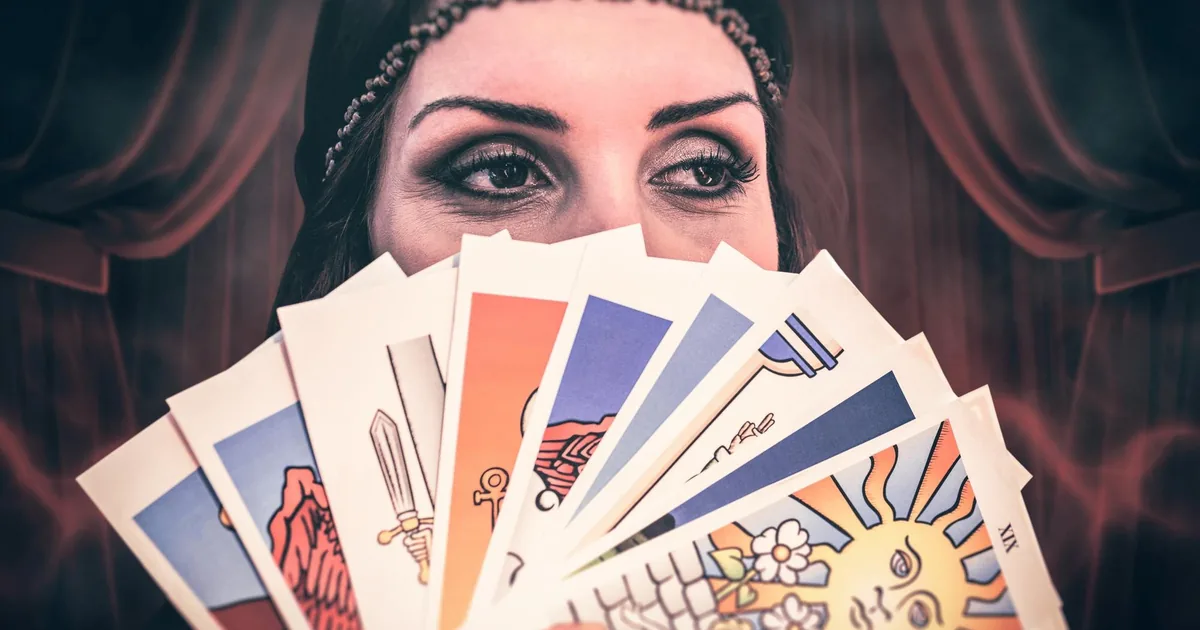
The secret is that tarot is not a set of fixed meanings, but a visual language. Each card is a scene with characters, weather, objects, and mood. The major arcana describe major life stages and archetypes: the hero's journey from the Fool to the World. The minor arcana are about everyday life: feelings, money, conflicts, small victories. When you look at a card and describe what you see, you are already reading it. This is the meaning of tarot cards for beginners — not rote memorization, but observation.
In the Waite tradition, the most popular in the Russian-speaking world, each card is provided with a narrative. That is why the meaning of tarot cards waite is intuitively clearer than, say, the Marseille Tarot, where the minor arcana are just numerical suits. And decks like Aleister Crowley's Thoth Tarot add astrological and Kabbalistic correspondences, making the meaning of tarot cards thoth more complex, but also more layered.
A practical step: take one card, place it in front of you, and for five minutes write down everything that comes to mind. Not "correct" meanings, but associations. For example, the Hierophant with his keys and columns might remind you of a school teacher, a church, a mentor, or your own beliefs. After a week of such practice, you will notice that the meaning of tarot cards in a spread begins to reveal itself — through the context of the question and the surrounding cards.
If you are closer to a systematic approach, try linking the arcana with other tools for self-knowledge. For example, in the matrix of fate calculator, the same major arcana describe life tasks and growth points — and this is an excellent way to reinforce their meaning through personal experience.
Major Arcana: How to read big stories without a cheat sheet
The major arcana are twenty-two archetypes that describe the entire human journey: from the naive Fool to the completed World. Their meaning of tarot cards major arcana is not reduced to a single word. Each arcana is a whole chapter of life, and in a spread, it almost always points to an important stage, not a mundane detail.
Let's take the Hermit. In a classic dictionary, this is "solitude, search for truth." But in a real relationship spread, it can mean that a person is tired of superficial communication and wants to figure themselves out before building intimacy. In a work spread — that it's time to take a break and reconsider goals, not chase a new position. In the "advice" position — that the answers are currently inside, not in a friend's advice.
How to read the major arcana without cramming? Use three questions for each card:
- What stage of life does it describe? (beginning, crisis, completion, lesson)
- Who or what does it depict? (a person, a situation, an internal state)
- What is it asking you to do? (act, wait, let go, accept)
For example, the Wheel of Fortune in the "past" position speaks of cyclicity: what is happening now has happened before. In the "future" position — about a turn you don't fully control. And in the "what to do" position — about the need to accept change and not cling to the old.
Note: the meaning of tarot cards upright and reversed can differ significantly. The reversed Hierophant often signifies dogmatism, hypocrisy, or rejection of authority, not just a "bad teacher." The meaning of tarot cards reversed is not necessarily negative, but rather a distortion or delay of the card's energy.
| Symbol / Image | Traditional Meaning | Manifestation in Life | What to Do |
|---|---|---|---|
| Fool (0) | Beginning, spontaneity, faith | New project, move, acquaintance | Take the first step without calculating everything |
| Hierophant (V) | Tradition, mentor, rules | Education, church, family foundations | Find a teacher or reconsider beliefs |
| Tower (XVI) | Crisis, destruction, insight | Firing, divorce, sudden truth | Accept the loss and rebuild |
This approach turns the meaning of tarot cards in spreads from a memorized list into a living story. And the more you practice, the faster the major arcana begin to "speak" on their own.
Minor Arcana: Meaning of tarot cards in relationships, work, and money
The minor arcana are fifty-six cards that describe everyday life. Their meaning of tarot cards minor arcana often seems simpler, but this is where beginners get confused: too many similar stories. The secret is to look at the suit and the number.
The suit sets the sphere: Cups — feelings and relationships, Pentacles — money and body, Swords — thoughts and conflicts, Wands — energy and actions. The number sets the stage: Ace — beginning, Two — choice or balance, Three — growth, Four — stability, Five — crisis, Six — harmony, Seven — trial, Eight — movement, Nine — result, Ten — completion.
Now let's take the meaning of tarot cards twos. Two of Cups — meeting, partnership, reciprocity. Two of Pentacles — juggling tasks, lack of time. Two of Swords — internal conflict, closed-offness. Two of Wands — choosing a path, planning. One number, but four different stories — and all because the suit changes the context.
Especially often asked about the meaning of tarot cards for relationships. Here it is important to look not only at the card but also at the position. The Three of Swords in the "partner's feelings" position can mean pain or hurt, and in the "advice" position — the need for an honest conversation that will bring relief. The meaning of tarot cards for feelings is always clarified by the question: "What exactly does this person feel?" — and then the Nine of Cups will speak of contentment and wish fulfillment, while the Five of Cups will speak of regret and focus on losses.
In the meaning of tarot cards in work and money, Pentacles play a key role. Ace of Pentacles — new job or income, Eight of Pentacles — diligence and learning, Ten of Pentacles — stability and inheritance. But don't forget: the meaning of tarot cards ace of any suit is always potential, not a guarantee. The Ace of Swords can bring clarity, or it can bring a sharp word that destroys relationships.
| Common Myth | Why It's Not So | How It Really Is |
|---|---|---|
| "A reversed card is always bad" | Reversed position is a distortion, not a sentence | The reversed Ace of Cups can mean suppressed emotions, not their absence |
| "If the Tower falls, expect trouble" | The Tower speaks of destroying the old, not punishment | It often comes when a person is stuck in an illusion and it's time to change something |
| "The meaning of tarot cards is the same for everyone" | The context of the question and surrounding cards change the meaning | The same card in a love spread and a career spread is read differently |
Practical advice: keep a spread journal. Write down the question, the cards that fell, and how the event manifested in a week. In a month, you will see that the meaning of tarot cards for love divination or for work has already formed for you — personal, tested by experience.
Meaning of tarot cards in a spread: context is more important than a dictionary
One card outside a spread is just a symbol. But as soon as it falls into a position, its meaning of tarot cards in a spread changes. The "past" position is read differently than the "future," and "advice" — differently than "fear." That is why mechanical memorization of meanings doesn't work: you are learning words, but you need to learn grammar.
Imagine you are doing a relationship spread, and in the "what the partner feels" position, the Eight of Swords falls. In a dictionary, this is "restrictions, trap, helplessness." But in the context of feelings, it can mean that a person is afraid to admit their emotions, feels bound by obligations or past experience. And if the Six of Cups lies nearby — perhaps they are still living in memories of past relationships.
How to read the meaning of tarot cards in spreads consciously? Use the "three layers" method:
- The first layer — literal: what is depicted on the card.
- The second layer — contextual: how it relates to the question and position.
- The third layer — intuitive: what you feel looking at the card.
For example, the meaning of tarot cards person is often described through the court cards. Page — novice, Knight — active, Queen — mature, King — authoritative. But the meaning of tarot cards man is not reduced to gender: the King of Cups can describe an emotionally mature person regardless of who is in front of you. And the meaning of tarot cards in relationships is often built on a combination of court cards: if there are many Cups in the spread, it's about feelings; if Swords — about conflicts and thoughts.
Another important point is the meaning of tarot cards reversed in a position. A reversed card in the "what to do" position can mean "don't do this" or "do the opposite." Reversed in the "result" position — that the card's energy is blocked or delayed. Don't be afraid of reversed cards: they add nuance, not fear.
If you want to delve deeper into other systems of divination and self-knowledge, check out other practices in the EXETERIC blog — there are materials on runes, oracles, and working with intuition.
How to read the meaning of tarot cards without cramming: practical techniques
The most common beginner question: "How long does it take to learn the meanings?" Answer: you don't need to learn. You need to practice. The meaning of tarot cards for beginners is revealed through three simple techniques that don't require memorization.
Technique 1: "Describe the scene." Take a card and tell what is happening on it, as if you are describing a picture to a friend. Who are these people? What are they doing? What's the weather? What's hanging on the wall? After two weeks of such practice, you will notice that the meaning of tarot cards upright and reversed is remembered on its own — through images.
Technique 2: "One card a day." In the morning, draw a card and write down your first impression. In the evening, compare it with how the day went. This develops the connection between symbol and reality. In a month, you will know exactly what the Six of Wands or Five of Pentacles means to you — not from a book, but from experience.
Technique 3: "Story from three cards." Draw three cards and compose a short story: beginning, development, ending. This teaches you to read the meaning of tarot cards in a spread as a single narrative, not as a set of separate symbols.
And one more piece of advice: don't ignore classic sources. Mary Greer's book "The Complete Tarot" or the works of Hajo Banzhaf provide a system that helps organize intuition. But remember: the meaning of tarot cards waite is the foundation, and your personal reading is what makes the spread alive.
| Situation | Reactive Approach | Conscious Practice | Result |
|---|---|---|---|
| A scary card falls (Tower, Death) | Panic, abandoning the spread | Look at the position and surrounding cards | Understanding that the card speaks of change, not an end |
| Can't remember meanings | Cramming lists | Daily practice of "one card a day" | Personal associations that are not forgotten |
| The spread seems contradictory | Searching for the "correct" answer on the internet | Write down the question and return to it in a week | Events themselves show what the card meant |
Practice on simple questions: "What awaits me today?", "What to pay attention to in a conversation?" This way, the meaning of tarot cards for feelings and everyday situations will manifest faster than on complex questions about fate.
Meaning of tarot cards thoth and other systems: how approaches differ
Most Russian-speaking tarologists start with Waite, but over time many come to other systems. The meaning of tarot cards thoth, created by Aleister Crowley and Frieda Harris, differs in greater astrological and Kabbalistic loading. Here, each card is tied to a zodiac sign, planet, or element, and the minor arcana have names like "Lord of Ruin" or "Lord of Success."
For example, in Thoth Tarot, the Two of Swords is called "Peace," but its meaning is not tranquility, but a balance of forces, a frozen confrontation. And the Three of Swords is "Sorrow," which is closer to the classic meaning. If you are used to Waite, switching to Thoth will take time: you will have to rebuild associations. But the meaning of tarot cards thoth provides a deeper understanding of astrological correspondences, which is useful if you are studying the astrology section.
There are other systems: Marseille Tarot with its game roots, Visconti-Sforza Tarot with historical narratives, modern oracles. But the principle remains the same: the meaning of tarot cards is not a dogma, but a tool for dialogue with the subconscious. The more systems you try, the richer your personal language of symbols becomes.
What to do if you are confused by the differences? Return to the foundation: take Waite and work through the major arcana through personal experience. And then add other decks as an extension, not a replacement. And remember: the meaning of tarot cards in relationships or in work does not depend on which deck you have in your hands — it depends on your honesty with yourself and your willingness to see reality, not just what you desire.
And the last practical point: if you are doing a love divination, don't forget that the meaning of tarot cards for love divination always takes into account the free will of both people. The cards show tendencies and energies, but not a sentence. The Two of Cups may foretell a meeting, but it is up to you whether you decide to take it. The Three of Swords may point to pain, but only you choose how to live through it. This is the conscious approach to tarot: not a search for ready-made answers, but a conversation with yourself through symbols.

Tarot as a conversation with yourself: a path without fear and haste
When you have reached this line, you have already done the main thing — you have stopped perceiving tarot as an exam you need to pass with an "A." The meaning of tarot cards is not tested by a test and does not require perfect memory. It grows with you: through observations, mistakes, quiet morning spreads, and honest evening journal entries. And this is much more valuable than a memorized list from a book.
Esotericism in general — and tarot in particular — is not a panacea or a magic pill for all questions. It is a tool for self-knowledge and conscious living. The cards do not decide for you, do not predict the future with one hundred percent accuracy, and do not remove responsibility. They only illuminate what you may not want to notice: your fears, desires, repeating scenarios. And this is their strength — not in mystical omnipotence, but in an honest mirror.
If you want to move forward, don't rush. Check out the EXETERIC practice — it contains calm, careful approaches to working with symbols, without scare tactics and promises of "removing the evil eye in one session." And if you are interested in how the same archetypes work in other systems, look at the materials of the astrology section — sometimes looking through the prism of your zodiac sign helps you see a familiar card in a completely different way.
And most importantly: don't be afraid of the unclear. If a card "doesn't fit," if a spread seems contradictory, if you are confused by reversed meanings — this is normal. Just put the deck aside for a day or two, return to simple questions, draw one card in the morning and see how the day responds. Gradually, the language of tarot will become as natural to you as your native speech. And if you want support and inspiration, read articles about magic and self-knowledge in the EXETERIC blog — there are many warm materials for those who are moving at their own pace.
Try it right today: take a deck, draw one card, and simply describe it aloud, as if telling a friend about a painting in a museum. Without the goal of "guessing the meaning," without fear of being wrong. With respect for the symbol and for yourself. This is how tarot turns from a frightening practice into a quiet conversation with your own depth — and this is perhaps the most valuable thing it can give.
Frequently Asked Questions
How long does it take to start reading the major arcana without a cheat sheet?
It's different for everyone, but with daily practice of "one card a day," the first confident associations appear in two to three weeks. This doesn't mean you will memorize all twenty-two arcana by heart — rather, you will start recognizing them by mood and images. In a month or a month and a half, you will notice that when you look at the Hermit or the Wheel of Fortune, you already have a personal, living understanding, not a bookish formulation. The main thing is not to chase speed and not compare yourself to others. Tarot doesn't like haste, but generously rewards regularity.
What to do if a major arcana in a spread seems too general and unclear?
When a major arcana falls and you don't know how to apply it, start with the question: "What stage of life does this describe?" The major arcana almost always speak of large processes — the beginning of a path, a crisis, a lesson, the completion of a cycle. Look at the card's position: in the "past," it explains the cause; in the "future," the tendency; in the "advice," the direction. Then ask yourself three questions: who or what does the card depict, what is it asking you to do, and how does this relate to your question. If it really doesn't fit, put the spread aside for a week and return to it with new experience — often the meaning reveals itself.
Can you read the major arcana only by the picture, without knowing the traditional meanings?
Yes, and this is one of the most honest ways to start. In the Waite tradition, each card is a small scene with characters, objects, and mood, so a visual description already gives half the meaning. If you see people falling and lightning on the Tower, you already understand: it's about sudden destruction and insight. Classic meanings are needed as a support so as not to go into fantasies, but they should not replace your own view. Over time, intuitive reading and book knowledge merge — and then the major arcana begin to speak to you in your own language.
How does reading the major arcana in Waite differ from Thoth Tarot?
In Waite, the major arcana are read through narrative and archetype: Fool — beginning, Hierophant — tradition, Tower — crisis. In Crowley and Harris's Thoth Tarot, astrological and Kabbalistic correspondences are added to each card, so the meaning becomes more layered. For example, the Two of Swords in Thoth is called "Peace," but it means not tranquility, but a frozen balance of forces. If you are used to Waite, switching to Thoth will take time: you will have to rebuild associations. However, Thoth provides a deeper understanding of elements and planets, which is useful if you are studying astrology.