Runes: 24 Symbols That Change Destiny — A Guide for Beginners
What are runes and why do the 24 signs of the Elder Futhark still work
Runes runes. When we say "runes," most people imagine stones with angular symbols that are pulled out of a pouch in a dark room. In reality, behind this image lies a coherent system that is over two thousand years old. Runes are not just divination signs. They are the ancient writing of the Germanic and Scandinavian peoples, where each rune is simultaneously a letter, a sound, a name, and an independent symbol with its own character and energy.
The Elder Futhark — this is what the classic set of 24 signs is called — is divided into three groups of eight runes each: the aett of Frey, Heimdall, and Tyr. This division is not accidental: it reflects three levels of being — creation, trial, and spiritual outcome. It is this set that is most often used in modern practice when it comes to rune divination and working with intention.
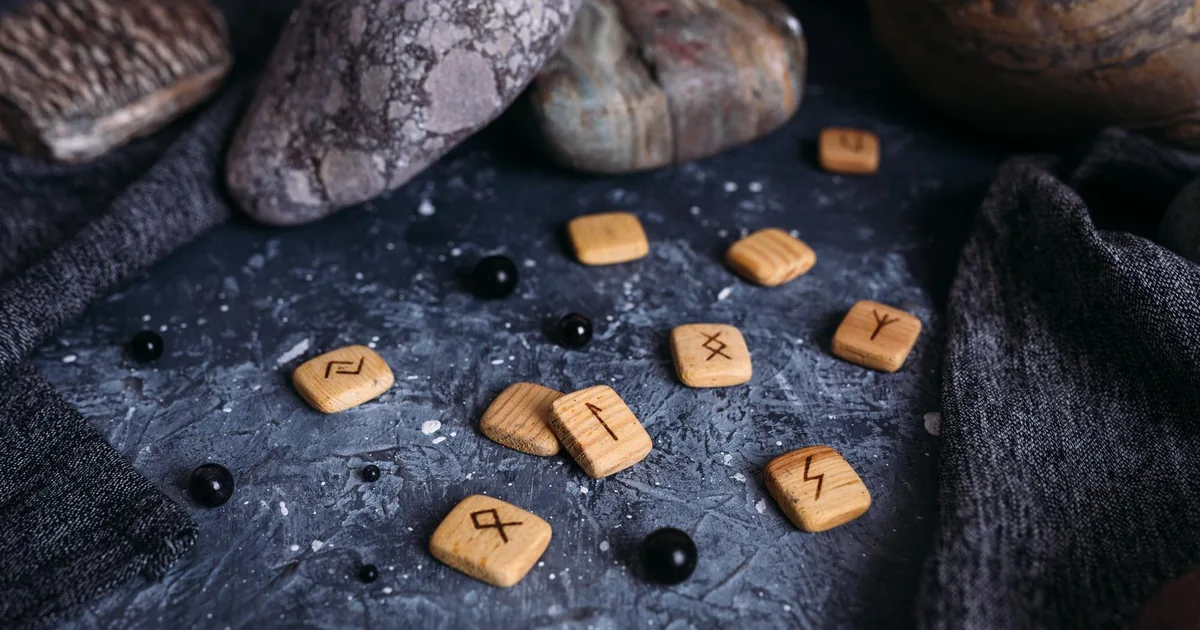
Why does a system devised for carving inscriptions on stone still resonate with people far from Scandinavia? From a psychological perspective, runes are archetypal images, similar to Tarot cards. They do not predict the future like a train schedule. They show the state you are in and the energy already activated in your situation. Runes and their meaning are the language through which the subconscious speaks to you via symbols.
That is why a thoughtful approach to the subject is more important than speed. If you are just starting out, there is no need to immediately buy ten sets and sign up for all the courses. One set, a notebook, and a sincere interest in yourself are enough. In other practices on the EXETERIC blog, we have repeatedly emphasized: a tool works only as consciously as you approach it.
Scandinavian runes and Slavic runes: what is the difference and what to choose
One of the first questions a beginner asks is: which runes are "correct"? Scandinavian runes, or the Elder Futhark, are a historically documented system used in Northern Europe. Slavic runes are a reconstruction based on later sources and researchers' hypotheses. Both traditions have a right to exist, but they work differently.
Scandinavian runes are built into a clear system with a mythological context, rune by rune: each is associated with a god, an element, or a plot from the "Poetic Edda." Slavic runes are more often associated with natural forces and protective practices. If you resonate with Northern mythology and want to work with a clear structure — take the Futhark. If your native tradition and soft natural images resonate — try the Slavic runes.
It is worth separately mentioning the so-called "black runes." This term is more common in popular literature and on the internet than in academic sources. It is sometimes used to refer to signs associated with destruction, change, or shadow aspects. But it is important to understand: within the Futhark itself, there are no "evil" runes. There are runes that speak of crisis, loss, or the need to let go — and this is not a curse, but an honest diagnosis.
| Criterion | Scandinavian runes (Elder Futhark) | Slavic runes |
|---|---|---|
| Historical basis | Written sources, archaeology | Reconstruction, later sources |
| Number of signs | 24 + blank rune (optional) | Different systems, often 18–25 |
| Area of application | Divination, magic, self-knowledge | Amulets, nature magic |
| Difficulty of learning | Medium, lots of literature | Medium, fewer verified sources |
If you are looking for where to study runes systematically, start with one tradition and do not mix sets in one spread. Mixing is a common beginner's mistake that disrupts intuition and makes interpretation contradictory.
Runes and their meaning: how to read the 24 signs of the Elder Futhark
The meaning of runes is not a dictionary to be memorized. It is more like a set of keys that open different doors depending on the question. Nevertheless, a basic understanding is necessary so as not to "read coffee grounds." Let's break down the logic of the Futhark by aetts.
First aett: runes of creation and resource
Fehu, Uruz, Thurisaz, Ansuz, Raidho, Kenaz, Gebo, Wunjo — these are runes that speak of beginnings, strength, protection, knowledge, path, creativity, partnership, and joy. The rune Fehu, for example, is associated with movable property, the energy of money, and the resource that comes and goes. If it appears in a work spread, it is often not about "magical earnings," but about how you manage what you already have.
Uruz is primal force, health, endurance. Thurisaz is protection and an obstacle that forces you to stop and think. Ansuz is word, information, learning. Raidho is road, movement, rhythm. Kenaz is the fire of creativity and clarity. Gebo is gift, exchange, partnership. Wunjo is joy, satisfaction, harmony.
Second aett: runes of trials and transformation
Hagalaz, Nauthiz, Isa, Jera, Eihwaz, Perthro, Algiz, Sowilo — these are runes that often frighten beginners. Hagalaz is hail, the destruction of the old. Nauthiz is need, necessity. Isa is ice, a stop. But it is these signs that give the most honest answer: where you are stuck and what needs to be let go. The rune for protection is most often associated with Algiz — the elk rune, which symbolizes intuitive defense and connection with higher powers.
Third aett: runes of spirit and outcome
Tiwaz, Berkano, Ehwaz, Mannaz, Laguz, Ingwaz, Dagaz, Othala — these are runes that speak of victory, growth, movement, human community, flow, fertility, breakthrough, and legacy. Othala is the rune of home, lineage, roots. It often appears when it is time for a person to sort out family patterns. By the way, in the fate matrix calculator, the logic is similar: we look at ancestral tasks through numbers, and in runes — through symbols.
Important: runes gain meaning and interpretation only in the context of a question. The same rune for love and for a career will sound different. Therefore, do not memorize tables — learn to ask precise questions.
Runes divination: how to ask a question and read a spread
Divination on runes is not a ritual with candles and mantles, although the atmosphere helps you tune in. It is a dialogue. And the quality of this dialogue depends on how accurately you have formulated the question. "What awaits me?" is a poor question. "What is important for me to understand in my relationship with my partner right now?" is a good one. "Should I change jobs?" is also a workable option, if you are ready to hear not just "yes" or "no."
A classic one-rune spread is the most honest for a beginner. You formulate a question, shuffle the runes in the pouch, set an intention, and draw one sign. Three runes are a "past — present — future" or "situation — obstacle — advice" spread. Five or more are for those who are already confident in reading symbols.
Runes divination online is a separate topic. A random number generator does not replace a physical set, but can be useful for training: you learn to formulate a question and interpret the answer without being tied to the "correct" stone. If you are more drawn to visual tools, see how the astrology section works — the logic is the same: symbols describe a state, not dictate a fate.
| Type of spread | When to use | Number of runes | What it shows |
|---|---|---|---|
| One rune | Quick advice, daily practice | 1 | The essence of the situation, the main vector |
| Three runes | Analyzing a situation, relationships, a choice | 3 | Cause, development, outcome |
| Five runes | Complex query, strategy | 5 | Hidden factors, resources, risks |
| Cross | Deep analysis, annual forecast | 5–7 | A multi-dimensional picture |
After the spread, do not rush to close the notebook. Write down the rune, the question, and the first association. Return in a week and see how the symbol manifested in your life. This is how you build a personal dictionary of meanings — it will be more accurate than any book.
Runes magic of runes: for protection, for love, and for resource
The magic of runes is not about controlling people or "love spells." It is about working with intention and energy. In the Northern tradition, runes were carved on objects to enhance their properties: on weapons for protection, on jewelry for luck, on tableware for abundance. Today, runes for protection are most often applied to amulets or used in the form of a stave — a combination of signs united by a single task.
Runes for love are not about making a specific person fall in love. It is about revealing your own ability to love and be open. Gebo, Berkano, Wunjo — these signs help tune into partnership, not manipulation. If you are looking for how to use runes in relationships, start with an honest question: "What prevents me from being intimate?" — not "How to make him call?"
Runes Slavic amulets work on a similar principle, but based on natural symbols. They are often embroidered on clothing or burned into wood. The main rule: an amulet is not a shield from the whole world, but a reminder of your intention. If you wear it while living in fear, it will not help. If you wear it and act consciously — it becomes a point of support.
We will separately mention runes listen. There are practices where runes are used as sound keys: the names of the runes are spoken aloud or recordings with reconstructed pronunciation are listened to. This helps to connect more deeply with the symbol, especially if you learn through an auditory channel. Try to pronounce "Fehu," "Uruz," "Ansuz" slowly, on an exhale, and track what sensations arise in the body.
Runes for beginners: where to start and how not to quit
The first step is to choose a set. These can be stones, wooden tablets, or bones. The material is not as important as your attitude. If you bought runes in a store, rinse them under water, let them dry, and hold them in your hands, stating your intention: "I work with these runes for clarity and self-knowledge." This is not magic for magic's sake, but a way to tune in.
The second step is to start a journal. Each day, draw one rune and write down: what sign it is, what it means to you, what happened during the day. In a month, you will have 30 personal observations — this is more valuable than a hundred foreign interpretations. If you need structure, start by studying one aett per week: this way you will not overload your memory.
The third step — do not compare yourself to "masters." On the internet, you can find runes Olga, Olga tarot runes, and other personal brands — these are authors who share their experience. Respect their path, but remember: your path is unique. Some start with Tarot, some with runes — both can lead to a deep understanding of yourself. If you are interested in how dreams work, look at the EXETERIC dream dictionary — there we analyze how the subconscious speaks through images, and this perfectly complements runic practice.
The fourth step is practice. Without regularity, runes will remain beautiful pebbles. Five minutes a day is better than three hours once a month. And do not be afraid of making mistakes: an incorrect interpretation is also part of the learning process.
Book runes and other sources: what to read to not get lost in myths
When you have mastered the basic meanings, you will want to go deeper. Here it is important to choose sources that do not turn runes into a bogeyman. Start with the "Poetic Edda" — this is the primary source where runes are mentioned in the context of myths. Next are the works of modern authors who write about the psychological approach to runes. Be wary of books that promise "wish fulfillment in 24 hours": this is marketing, not tradition.
A good book runes is one that explains not only the meaning but also the context: where the sign came from, how it is connected to a myth, how it was used in everyday life. If the author offers exercises and questions for self-observation — this is a sign of quality material. And remember: even the best book cannot replace your practice.
If you want to compare runes with other systems, see how the Human Design guide is structured — it also has types and strategies that help make decisions. And in the articles on magic and self-knowledge, we regularly analyze how different tools complement each other.
And finally: do not try to learn everything at once. Runes are a marathon, not a sprint. Start with one rune a day, keep a journal, ask honest questions. In six months, you will be reading spreads confidently, and most importantly — understanding yourself more deeply. And if you want to figure out how runes and Tarot are connected — this topic deserves a separate conversation, and we will definitely return to it.
How to live with runes every day and not lose yourself
Runes are not a magic button that solves problems for you. They are more like a mirror: you look into it and see what you have long known but were afraid to admit. The twenty-four signs of the Elder Futhark do not change fate overnight — they change your attitude towards it. And this is their main value. When you draw Fehu and understand that it is time to sort out your finances, or see Hagalaz and realize that old connections have long been pulling you down — this is not magic. This is an honest conversation with yourself.
Esotericism in general and runes in particular are a tool for self-knowledge, not a panacea. They do not cancel work, therapy, healthy sleep, and the ability to say "no." They merely highlight what you already feel but are not yet ready to name. If you expect runes to bring you money, love, or luck without your participation — you will be disappointed. If you are ready to look deep and act consciously — they will become a reliable support. In the EXETERIC practice, we always emphasize: any tool works only as honestly as you approach it.
Do not be afraid of the unknown. If a rune seems "scary" or "evil" to you, this is not a reason to put the set in a far drawer. This is a reason to ask a question: what exactly in my life resonates with this symbol? Perhaps Isa is not about stagnation, but about the need for a pause. Perhaps Nauthiz is not about poverty, but about the fact that it is time to stop wasting energy on someone else's. This approach turns divination into therapy, and symbols into a language through which you learn to speak with yourself without fear and judgment.
If you want to move forward, start small. Look at the astrology section to see how other symbolic systems work, or read articles on magic and self-knowledge — there we analyze different tools without mystical fog. And if you are just at the beginning of the path, do not try to embrace the infinite. One rune a day, a journal, an honest question — this is enough to feel how your perception changes in six months. Runes do not dictate fate. They help you hear it.
Try it today: take one rune, place it in front of you, and ask what it is important for it to tell you. Do not look for the "correct" answer in books — listen to the first association. Write it down. Do the same tomorrow. In a week, you will be surprised at how much more precise your questions have become and how much calmer your decisions are. Esotericism is not an escape from reality, but a way to live in it more consciously. And may your path with runes be exactly like this: quiet, attentive, and your own.
Frequently Asked Questions
How many runes do you need to learn to start divination?
For the first steps, it is enough to know the meanings of all 24 runes of the Elder Futhark at least superficially, but you do not necessarily need to memorize them by heart. Start with one rune a day: draw it, write down associations, and observe how it manifests in your life. In a month, you will have a personal dictionary of 30 observations, which is more accurate than any book. The main thing is not the number of learned symbols, but the quality of your attention to them. Practice is more important than theory: five minutes daily will give more than three hours once a month.
Can you divine on runes for yourself and your loved ones?
You can divine for yourself and it is even helpful — it helps you hear your own thoughts without external noise. However, there is a nuance: when you are too involved in a situation, it is easy to substitute an honest answer with a desired one. Therefore, for important decisions, it is sometimes useful to ask another practitioner. You should only divine for loved ones with their consent and without imposing your interpretation. Runes do not like being used to control others. If a person is not ready to hear the answer, it is better to refrain from a spread.
What to do if the blank rune appears?
The blank rune, or Odin's rune, is not part of the classic Elder Futhark, but is often used in modern sets. It means that the situation is not yet formed, and the answer lies beyond your current understanding. This is not a bad sign and not "silence" — it is an invitation to trust the unknown and not force events. If the blank rune appears in a spread, do not try to "replay" it or draw another. Write down the question and return to it in a few days. Often the answer comes by itself, without additional signs.
How to store runes and care for them?
Runes do not require complex rituals, but a respectful attitude helps you tune in to work. Store them in a pouch made of natural fabric or a wooden box — this way they do not get lost and do not mix with other items. Periodically wipe the stones or wooden tablets with a dry cloth to remove dust and maintain tactile contact. If you feel that the set has become "contaminated" after heavy spreads, hold it under running water or fumigate it with herbs. The main thing is not to turn care into a mandatory ritual that causes anxiety. Care and attention are enough.