Fortune telling: card meanings and spreads — how to read the signs of fate
What fortune telling really is: a tool, not magic
Let's be honest: the word "fortune telling" evokes images of dark rooms, charlatans in velvet robes, and predictions of fate that cannot be escaped. But if we set aside cultural stereotypes and look at the practice soberly, it turns out that fortune telling is one of the oldest and most structured methods of working with intuition and the subconscious. It's not about "will he call tomorrow" or "will I win the lottery." It's about a dialogue with yourself through a system of symbols.
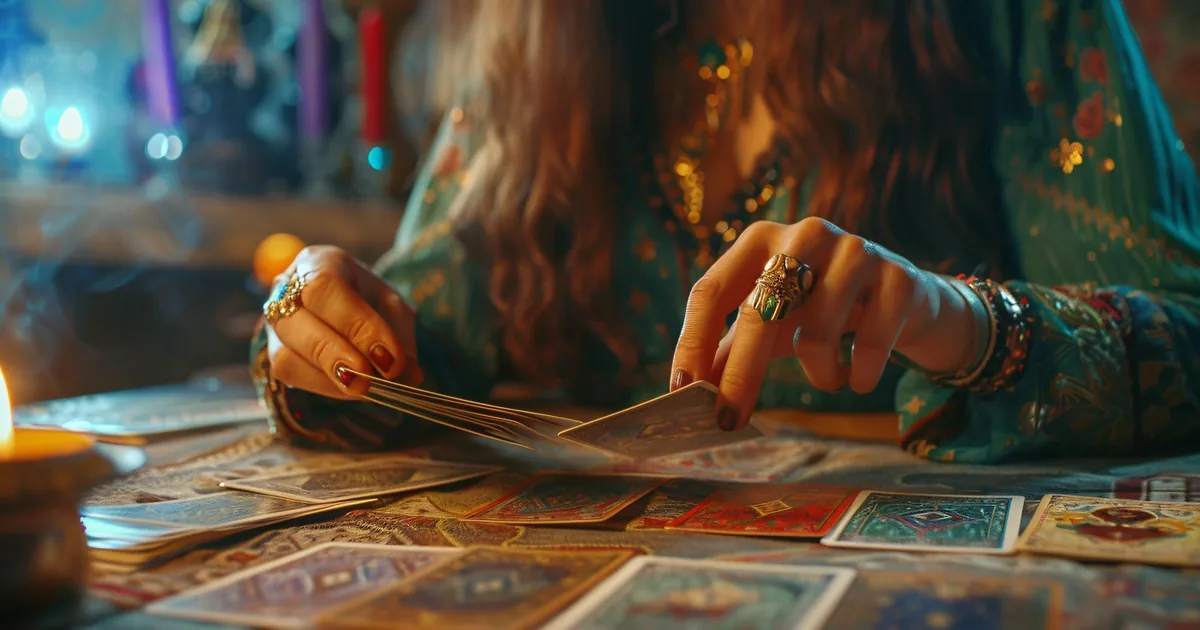
Each tool — whether it's a Tarot deck, runes, or Lenormand cards — is essentially a mirror. You ask a question, draw a card, and it reflects not an external future, but your internal state, hidden motives, and the potential for how the situation develops. Psychologist Carl Jung called this "synchronicity" — a meaningful coincidence when the external world resonates with your internal landscape. Therefore, professional fortune telling with cards is not guessing, but interpretation. You are not a passive recipient of information, but an active participant in the dialogue.
Imagine you ask the cards: "What is preventing me from making progress on my project?" And the Tower Arcana comes up. A beginner will see catastrophe and destruction. But a practicing person will understand: it's about fundamental beliefs that need to be torn down in order to build something new. The question is not about prediction, but about interpretation. And that is precisely what makes the practice valuable: it helps you see what you know but do not consciously recognize. If you want to understand more deeply how symbols and energies work in your life, check out the section on other practices in the EXETERIC blog, where we break down similar tools for self-discovery.
A practical step to begin: take any question that is currently troubling you, but does not require immediate action. Write it down in one sentence. Not "why am I lonely," but "what can I do to feel more whole in my relationships." A specific, open-ended question is the first step toward a conscious spread.
What kinds of spreads exist and how to choose your tool
The world of fortune telling practices is vast, and it's easy for a beginner to get lost. But in reality, it's simpler than it seems: tools are divided into several basic types, and the choice depends on what kind of question you want to ask. Let's break down the main directions so you can find your path without confusion.
Tarot is perhaps the most well-known and structured tool. A deck of 78 cards is divided into Major and Minor Arcana. The Major Arcana (22 cards) describe archetypal narratives: The Fool, The High Priestess, The Empress, Judgment. The Minor Arcana (56 cards) work with everyday situations: finances, relationships, actions. Tarot reading is especially good for complex, multi-layered questions: "What are my hidden motives in this situation?" or "What lesson am I supposed to learn?" Each card has a basic meaning, but the context of the spread changes everything. That's why it's important not to memorize interpretations, but to learn to feel the connections between cards.
Runes are a system of symbols from ancient Germanic peoples. Each rune is not just a letter, but an energetic sign carrying a specific vibration. Runes are good for short, concise questions: "What to do?" "What energy is abundant right now?" "What should I avoid?" They work faster and more sharply than Tarot, and require respect for tradition. It's important to understand: runes are not magic in a mystical sense, but a coordinate system for navigating real life.
Lenormand cards (or oracle cards) are a simpler and more straightforward tool. 36 cards with clear images: House, Heart, Star, Fish. They are perfect for quick, concrete questions: "Will this project be successful?" "How will the relationship develop over the next month?" Relationship fortune telling with Lenormand often gives a clear, pragmatic answer without excessive symbolic weight.
There are also runic systems, numerological spreads, dice, and sand. But it's better to start with one tool. Don't try to master everything at once — that's like learning five languages simultaneously. Choose what resonates with you and go deeper.
| Tool | Best suited for | Difficulty of learning | Style of answer |
|---|---|---|---|
| Tarot | Complex, multi-layered questions, self-discovery | High | Symbolic, metaphorical |
| Runes | Short, concise questions, energetic analysis | Medium | Direct, energetic |
| Lenormand | Quick, concrete questions, pragmatics | Low | Clear, figurative |
A practical step: determine what type of questions you ask most often. If they are abstract and philosophical — start with Tarot. If they are concrete and pragmatic — try Lenormand. If you want to quickly read the energy of the moment — runes. Don't be afraid to experiment, but give yourself time with each tool — at least a month of regular practice.
Fortune telling with cards: how to read meanings and not get lost in symbols
The main fear of a beginner is misinterpreting a card. "What if I interpret it wrong? What if it's a bad sign?" This fear paralyzes and turns the practice into a source of anxiety instead of clarity. Let's figure out how to read cards consciously, without panic and mystical pathos.
The first and most important rule: there are no "good" or "bad" cards. There are energies that require attention. Even the "scariest" card — Death, the Devil, the Tower — is not a verdict, but an indication. Death is transformation, the end of the old and the beginning of the new. The Devil is addictions, illusions, what keeps you in a cage. The Tower is the destruction of an unnecessary foundation. The question is not "is this a bad card," but: "What is it trying to tell me?"
The second rule: context decides everything. The same card in different positions of a spread will mean different things. For example, in a three-card spread (past — present — future), Death in the past position means you have already gone through a transformation. In the present position — you are in the process of change. In the future position — change awaits you. The same symbol, three different meanings. That's why it's important not just to know card interpretations, but to be able to weave them into a unified narrative.
The third rule: trust your intuition, but verify with logic. When you draw a card, pay attention to the first feeling — what did you feel? Joy? Anxiety? Surprise? That's your intuition speaking. But then engage your mind: what does tradition say? How does this card relate to your question? The balance between intuition and analysis is the key to accurate interpretation.
A practical example: you do a spread on relationships and draw the Knight of Cups in the position of "what I can do." Traditionally, this is a romantic suitor, a proposal, an emotional gesture. But your intuition whispers: "This is not about romance, but about the need to express feelings." And you understand: the card is telling you — be bolder in expressing emotions, don't hide behind a wall of rationality.
A practical step: keep a spread journal. Write down the date, the question, the cards drawn, your interpretation, and what happened afterward. In a month or two, you'll see patterns and understand how the cards "speak" specifically to you. This is invaluable experience that cannot be gained from books.
Love fortune telling: an honest conversation without rose-colored glasses
"Will he love me?" — the most common question people bring to the cards. And the most dangerous one. Why? Because it's built on the illusion that someone else's feelings can be predicted or controlled. Conscious love fortune telling works differently: it helps you see your own true needs, fears, and patterns, rather than predicting another person's behavior.
Let's be honest: you cannot know what's happening in another person's mind and heart. But you can know what's happening in your own. Therefore, the right question for a relationship spread is not "will he call," but "what can I do to make my relationships healthier?" or "what beliefs of mine are preventing me from being happy?" This is not devaluing your feelings, but respecting your freedom and responsibility.
A typical mistake is doing a relationship spread in a state of anxiety or despair. When you're stressed, your energy is "infected" with fear, and the cards will reflect that fear rather than the objective situation. That's why professional tarot readers recommend: before a spread, calm down, take a few deep breaths, and formulate your question clearly and calmly. If you can't do that — wait. A spread done in panic almost always leads to erroneous conclusions.
Another important point: relationship fortune telling does not replace working on yourself. The cards can show a pattern, but changing it is your task. For example, if a spread repeatedly shows that you attract people who are emotionally unavailable, that's not a "curse" or "fate." It's a signal: there's something in you that attracts this type of relationship. Perhaps a fear of intimacy, a habit of control, or low self-esteem. The cards point to the problem, but the solution is up to you.
A practical step: before a relationship spread, ask yourself three questions: 1) What do I truly want in a relationship (not "who," but "what")? 2) Am I ready for it? 3) What can I do right now to move closer to this? Write down the answers, and only then do the spread. You'll be surprised how often the answers to these questions already contain the solution, and the cards merely confirm your intuition.
Online fortune telling and free fortune telling: convenience vs depth
We live in an era where you can do a spread without getting off the couch. Apps, websites, online generators — everything is available with one click. And that's certainly convenient. But there's a nuance that's important to talk about honestly.
Online fortune telling is a great way to get acquainted with a tool, try different decks, and feel what resonates. Free apps often provide basic interpretations, help you memorize card meanings, and create a habit of regular practice. For a beginner, this can be an ideal entry point. But there's a limitation: you're working with an algorithm, not with energy. There's no live contact between you and the tarot reader, no space for dialogue, no opportunity to clarify, reformulate the question, or look at the situation from another angle.
Imagine the difference: you read a cookbook and cook a dish by recipe. That's good, you'll learn. But if you sit next to a chef and he shows you how to hold a knife, how to feel the dough, how to know when the sauce is ready — that's a completely different level. An online spread is the cookbook. A live spread is the masterclass. Both are useful, but for different tasks.
Another point: free fortune telling online often contains ads, prompts to "buy the full interpretation," or "ask a question for a fee." That's not bad, it's a business model. But it's important to understand: if a service insists on payment for an "accurate answer," it's most likely a marketing tactic, not an esoteric necessity. Real practice doesn't require money. It requires attention, time, and honesty with yourself.
A practical step: use online tools for learning and experimentation. Do spreads for free, record the results, compare them with real events. After a couple of months, you'll understand how accurate your interpretations are and whether it's worth going deeper. And if you feel you want more depth — find a practicing tarot reader you resonate with. Not because "they're better," but because live dialogue is always richer than an algorithm.
Fortune telling for the future: why predictions are not about fatalism
"What awaits me in the future?" — the second most popular question after love spreads. And here lies the main trap: the temptation to perceive the cards as a final verdict. "The card said it will be bad — so it will be bad." That's fatalism, and it contradicts the very essence of conscious practice.
Let's figure this out: the future is not something rigid, predetermined, and unchangeable. It's a field of possibilities shaped by your actions, decisions, and energy right now. Fortune telling for the future shows not "what will be," but "what will be if nothing changes." It's like a weather forecast: if there are clouds right now and you don't take an umbrella, you'll get wet. But you can take an umbrella, stay home, or go somewhere else. The clouds are not a verdict — they're information for making a decision.
A professional tarot reader will never say: "You will definitely get divorced." They will say: "The cards show tension in the relationship that could lead to a breakup if you don't start working on communication." The difference is enormous. In the first case — you're a victim of fate. In the second — you're an agent who receives information and acts. That's precisely what makes the practice valuable: it gives you not answers, but questions that help you make more conscious decisions.
A practical example: you do a career spread and draw the Five of Pentacles in the "near future" position. Traditionally, this is a card of loss, lack, and loneliness. A beginner will be scared. But a practicing person will ask themselves: "Where in my life is there a 'lack' right now? Finances? Attention? Support? What can I do to change that?" And the cards will point the direction: maybe you need to ask for help, maybe review your expenses, maybe find a mentor. The future is not predetermined — it's hinted at.
A practical step: when doing a spread for the future, always add a clarifying question: "What can I do to change this scenario?" This turns passive waiting into active action. And remember: if a spread shows a negative scenario — that's not a reason to panic, but an invitation to awareness.
Yes no fortune telling: a simple format for quick decisions
Sometimes you don't need a deep ten-card spread. Sometimes you need a quick answer: "Yes or no? Should I do this? Is this the right choice?" Yes no fortune telling is a simplified format that gives a clear, unambiguous answer. But, like any tool, it requires understanding its nature and limitations.
The simplest method is one card. Ask a question, draw one card, look at its overall message. Positive energies (Sun, Star, Ten of Cups) — lean toward "yes." Complex or tense ones (Tower, Devil, Five of Swords) — better to refrain or reconsider your approach. But even here, it's not so simple. One card is not "yes" or "no," but "here is the energy of this moment." And sometimes "no" is the best thing that can happen to you.
Another method is runes. Draw one rune and look at its meaning. Jera — "yes, time is working in your favor." Isa — "no, wait." Tyr — "yes, but courage will be required." Runes are good for quick decisions because they are concise and direct. But they require knowledge of the system: you can't just look at the picture and decide.
An important warning: don't do yes no fortune telling on the same question multiple times in a row. If the first answer didn't satisfy you and you repeated the spread hoping for a different result — you're not receiving information, you're seeking confirmation of your desire. That's not practice, that's playing roulette. If you're in doubt — wait at least three days, reformulate the question, and do the spread again.
A practical step: use the yes no format for small, everyday decisions: "Should I go to this meeting?" "Did I do the right thing?" This trains your intuition and helps you feel how the cards "answer" specifically to you. And for serious, life-changing decisions — do full spreads with multiple cards and positions.
Relationship fortune telling: a deep spread that changes perspective
Let's break down a specific technique that will help you see a relationship not as a set of events, but as a system of energies and patterns. This is the "Three Levels of Relationship" spread — it works for any situation: romantic, friendly, or business.
You'll need a Tarot or Lenormand deck. Draw three cards and lay them out horizontally. The first card — "What I bring into this relationship." The second — "What the other person brings." The third — "What is born between us." This spread is not about predictions, but about awareness. It shows what energies you contribute to the connection, what energies the partner brings, and what arises from that interaction.
A practical example: you do a spread on a relationship with a colleague. The first card — Knight of Wands (energy, initiative, action). The second — Hermit (autonomy, need for space). The third — Four of Cups (apathy, indifference). What does this mean? You bring activity and drive, the colleague brings a need for solitude. The result — emotional detachment. This is not a "bad relationship," but simply different energies that don't resonate. Knowing this, you can adjust your approach: give the colleague more space, reduce the pressure, find balance.
This spread is valuable because it shifts the focus from "the other person" to "the interaction." You're not trying to change your partner — you understand the dynamics and adjust your own position. That is conscious practice: not control, but understanding.
A practical step: do this spread right now for any relationship that's important to you. Write down the three cards and their meanings. Then think: what can you change in your own behavior to improve the dynamics? Don't wait for the other person to change — start with yourself. This is not self-sacrifice, but responsibility. And it's precisely that which makes relationships healthy.

Cards as a compass: your path to awareness
We've come a long way — from debunking myths about charlatanism to specific spread techniques. And if you've read this far, it means you're not just interested in the future. You're interested in understanding. Understanding yourself, your motives, the hidden driving forces that govern your decisions and relationships. That is precisely the essence of conscious esoteric practice.
Cards, runes, symbols — these are not magical crystals that grant wishes. They are more like a compass in the labyrinth of your psyche. They don't give ready-made answers to the question "what will be," but they help you ask yourself more precise questions: "what do I truly want?", "what beliefs are preventing me from moving forward?", "what role am I playing in this situation?" This is a tool for self-discovery that works at the intersection of intuition and analysis, symbol and reality.
Remember: no spread can replace your choice. The cards can show a tendency, reveal a pattern, outline possible scenarios, but the final decision is always yours. You are the author of your story, and the cards are merely editors who help you see typos and missed commas. Don't be afraid to experiment, try different tools, make mistakes, and learn from them. Every spread is a dialogue with yourself, and the more honest you are in that dialogue, the more valuable the result will be.
If you feel you want to go deeper and find your direction in the world of esoteric practices, check out the EXETERIC guide to esotericism. We don't make mystical promises, but we offer a structured, honest approach to self-discovery through ancient and modern tools. And for those who want to start small, we recommend exploring other practices in the EXETERIC blog, where we break down similar techniques — from meditations to working with the subconscious.
And, of course, don't forget that esotericism is just one of the cards on your table. To see the full picture, it's worth looking into other sections as well. For example, astrology can provide amazing context to your cards, showing how the energies of planets and zodiac signs influence your life. Check your zodiac sign, and you might find surprising coincidences with what your spreads show.
Don't be afraid of the unknown. Start small: one question, one card, one honest look at yourself. Practice with respect for the tool and for yourself. And remember that the real magic happens not in the deck, but in your conscious intention. Welcome to the path where every card is an invitation to greater clarity and harmony in your life.
Frequently asked questions
Can I do a spread on the same questions every day?
Doing a spread on the same question every day is not recommended, as it turns the practice into a search for confirmation rather than receiving new information. Each spread is a snapshot of the energy of the moment, and if you don't take any action between spreads, the result will repeat, which only amplifies your anxiety. Professionals advise waiting at least three days before asking the same question again, and during that time it's worth analyzing the previous answer and trying to apply it in practice. If after taking action the question is still relevant, then you can do a new spread, reformulating it in light of what you've already learned. Remember that the goal is not to get a "yes" or "no," but to understand how to move forward.
Why do different tarot readers give different interpretations of the same card?
Different tarot readers may give different interpretations of the same card because interpretation depends on the context of the spread, the reader's personal experience, and the intuitive connection with the client. A card is not a frozen symbol, but a living energy that resonates differently in different situations and with different people. For example, the Death card for one person may mean a fear of change, while for another — liberation from an old burden. A professional tarot reader takes into account not only traditional meanings, but also the card's position in the spread, its interaction with other cards, as well as your personal history and current circumstances. That's why it's important to find a practitioner you resonate with and trust not only their knowledge, but also your own feeling.
How do I know that the cards are speaking specifically to me, and not just aligning with my fears?
To understand that the cards are speaking specifically to you, and not just reflecting your fears, it's important to approach a spread in a calm, balanced state. If you do a spread in anxiety or despair, your energy is "infected" with fear, and the cards will reflect that fear rather than the objective situation. Before a spread, take a few deep breaths, formulate your question clearly and calmly, and try to let go of the expectation of a specific answer. Pay attention to the first feeling that arises when you see the card — that's your intuition speaking. Then verify that feeling with logic: how does the card relate to your question and current situation? If the interpretation feels far-fetched or overly alarming, perhaps it's worth waiting and doing the spread later, when you're in a clearer state.
What mistakes do beginners most often make in relationship spreads?
Beginners often make the mistake of asking about another person's feelings or actions, for example: "Will he call?" or "Does she love me?" This doesn't work because you cannot know what's happening in another person's mind and heart, but you can know what's happening in your own. The right question should be about you: "What can I do to make my relationships healthier?" or "What beliefs of mine are preventing me from being happy?" Another typical mistake is doing a spread in a state of anxiety or despair, when your energy is "infected" with fear, and the cards will reflect that fear. Finally, beginners often expect the cards to solve their problems for them, but practice shows that the cards merely point to a pattern, and changing it is your task. Conscious relationship fortune telling is not about controlling another person, but about working on yourself and understanding the dynamics of the connection.