Marriage Line on the Hand: Meaning in Palmistry
What is the marriage line in palmistry and why is it needed
Palmistry is not just fortune-telling by hand, but an ancient system that helps you understand yourself through the symbols imprinted on your palms. The marriage line is one of the most discussed, but also one of the most misunderstood. Many perceive it as a verdict: "if the line is short — the marriage will be unsuccessful," "if it is forked — expect infidelity." This is a simplification that frightens and misleads. In reality, the marriage line on the hand in palmistry is not a map of fate, but a clue about your emotional experience and your ability to build close relationships.
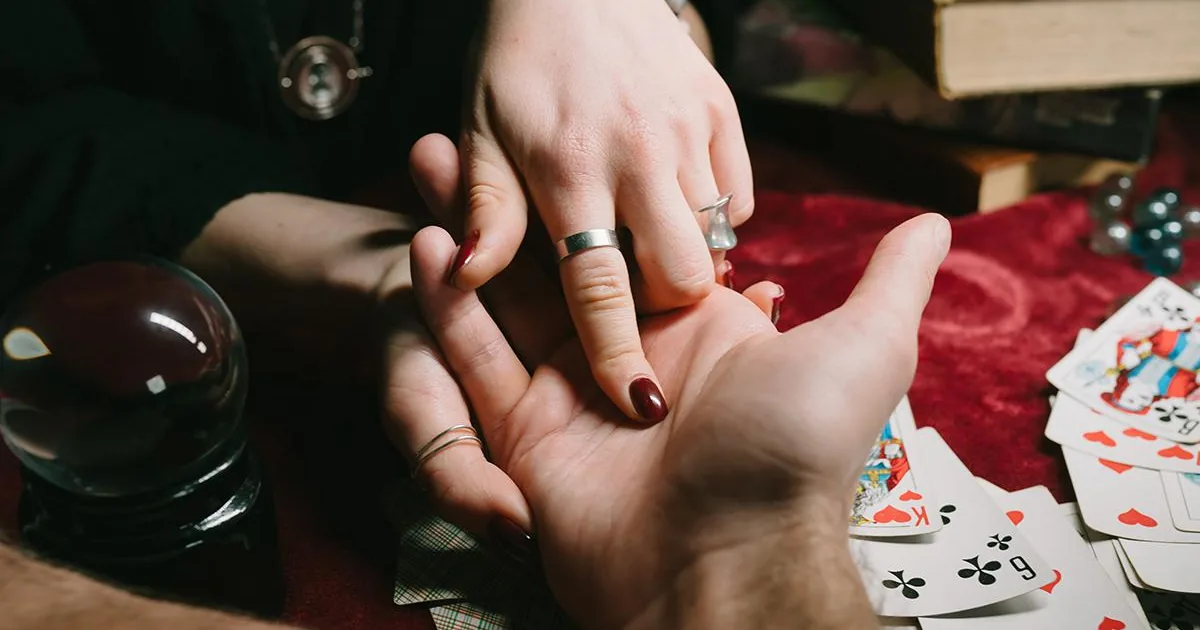
In classical palmistry, the marriage line is located on the edge of the palm, slightly above the heart line, and runs horizontally toward the outer side. It symbolizes not only official marriage, but also deep emotional connections: romantic relationships, long-term unions, even significant friendships. That is why it is also called the relationship line or the line of attachment.
Why does this topic stir so much emotion? Because relationships are a sphere where we want clarity. We want to know whether we will meet "the one," whether the union will be strong, whether a mistake will repeat itself. And the hand, as a mirror of the soul, can provide answers — if you read it consciously, not as a prediction, but as a tool for self-discovery.
In this article, we will examine how to correctly find the marriage line, what its length, depth, breaks, and signs mean. You will learn to look at your hand not with fear, but with the curiosity of a researcher. And most importantly — you will understand that the marriage line on the hand in palmistry is not a verdict, but a reason to reflect on your patterns in relationships.
How to find the marriage line on the palm
Before interpreting, you need to accurately determine where the marriage line is located. Many beginners confuse it with the heart line or random creases. Let us break it down step by step.
Location of the line
The marriage line is located on the edge of the palm, on the side of the little finger. It starts from the edge of the palm and extends horizontally toward the center, often crossing the heart line or sitting slightly above it. Usually there can be one, two, or even three such lines. Do not be alarmed — having several lines does not mean several marriages; it is rather an indication of different significant connections in life.
To find it, bend your palm so that creases appear on the edge. The marriage line is usually visible as one of these creases, but it is more distinct and longer than random wrinkles. Look at the area between the base of the little finger and the heart line — that is the search zone.
Common beginner mistakes
A frequent mistake is mistaking a line that runs toward the little finger for the marriage line, or confusing it with the intuition line. The intuition line is usually located lower, closer to the wrist, and runs in an arc. The marriage line is always horizontal and starts from the very edge of the palm. If the line does not start from the edge but appears from the middle — it may be a branch from another line, and it should be interpreted with caution.
Another subtlety: in some people, the marriage line can be so faint that it is barely visible. This does not mean you will not have relationships — it simply means your emotional sphere is not the main focus in this life. Or you tend to hide your feelings.
Key characteristics of the marriage line
Once you have found the line, pay attention to its length, depth, clarity, and position. These parameters are the foundation for understanding.
Length and depth
A long and distinct marriage line that extends from the edge of the palm toward the center indicates a stable and harmonious union. The longer the line, the longer and deeper the relationship. But do not confuse length with a guarantee of happiness — a long line may indicate a long-lasting relationship, but not always its quality.
A short line is not a verdict. It may mean that important relationships will be short in duration but very intense. Or that you are not inclined toward long-term attachments, preferring freedom. Remember that palmistry is not an exact science, but an art of interpretation.
The depth of the line shows the strength of emotional involvement. A deep, distinct line — you give yourself fully to relationships, your feelings are profound. A weak, shallow line — you may be more reserved in expressing emotions, but that does not mean you are incapable of love.
Position relative to the heart line
The distance between the marriage line and the heart line matters. If the marriage line almost touches the heart line — you enter relationships very emotionally, sometimes impulsively, guided by impulse. If there is a noticeable gap between them — you are more rational and choose a partner with your head, not your heart.
The slope of the line is also important. If the marriage line goes upward, toward the fingers — this is a sign that you tend to idealize your partner and may become disappointed when reality does not match expectations. If the line slopes downward — you are more grounded and practical in relationships, but may underestimate the emotional side.
Signs on the marriage line: dots, breaks, forks
Now let us move on to the most interesting part — the signs that may appear on the marriage line. These are symbols that palmists interpret as indicators of events or traits. But remember: signs are not fate, but clues for reflection.
| Symbol / image | Traditional meaning | Manifestation in life | What to do |
|---|---|---|---|
| Dot or indentation | Sudden halt or crisis in a relationship | You may experience a breakup that leaves a mark, or a painful event within the union | Do not fear dots — this is a sign that you need to pay attention to your emotional wounds and work through them |
| Break in the line | Breakup of a relationship, but with the possibility of reunion if the line continues after the break | A separation that may be temporary or final depending on the continuation | Analyze what led to the breakup and decide whether you want to restore the connection or let it go |
| Fork at the end | Division or choice between two partners, sometimes — divorce | You may be facing a difficult choice in relationships, or the union may fall apart | Take time for reflection, do not act impulsively. A fork may also mean an internal conflict |
| Island | A period of doubt, uncertainty, emotional tension | A difficult period arrives in the relationship when you are unsure of your feelings | Reach out to your partner for an open conversation, clarify the situation |
| Cross on the line | An obstacle, external circumstances hindering the relationship | Problems at work, with relatives, financial difficulties — everything that pressures the union | Seek compromises, strengthen the partnership to overcome difficulties together |
| Star | A fateful meeting, strong passion, but also possible trials | The relationship will be bright, but may be unstable | Enjoy the moment, but stay mindful so as not to get burned |
Each sign is not a verdict, but an invitation to reflection. For example, a dot on the marriage line may indicate a period when you experienced deep disappointment, but that does not mean you cannot be happy in the future. Palmistry helps you see patterns, and changing them is within your power.
The marriage line on the right and left hand: what is the difference
In palmistry, it is customary to distinguish between the left and right hand. The left hand reflects what you came into this life with: your karmic tasks, innate tendencies, potential. The right hand shows how you realize that potential, what you have gained through experience and effort. Therefore, the lines on the hands may differ.
If the marriage line on the left hand is long and distinct, while on the right hand it is short or broken, this indicates that your innate expectations of relationships have collided with reality. Perhaps you have experienced disappointments that changed your view of love. Conversely, if the line on the left hand is weak and on the right hand is strong, you have managed to overcome your fears and build healthy relationships despite an initial tendency toward withdrawal.
It is important to look at both hands as a whole. For right-handed people, the right hand is considered active and reflects conscious choices, while the left is passive, the hereditary program. For left-handed people — the opposite. But even if you do not remember which is your dominant hand, simply compare the lines: if they differ significantly, it is a reason to reflect on how you are developing your emotional sphere.
The marriage line and the number of relationships
Many ask: "how many marriages will I have?" and count the marriage lines. But palmistry says something different: each marriage line is not necessarily a marriage, but rather a significant connection that left a mark on your soul. A person may have two or three pronounced lines, and this does not mean you will divorce twice. It may mean that there will be several deep connections in your life: for example, first love, a serious relationship, and then marriage.
Sometimes the marriage line forks at the end — this is not always a prediction of divorce. It may indicate that there will be two parallel attachments in your life: for example, love for a partner and love for a child, or you will be torn between family and career. So do not panic at the sight of a fork.
If there are no marriage lines at all, this does not mean you are doomed to loneliness. It may indicate that other spheres of life are more important to you: creativity, spiritual growth, self-realization. Or you hide your feelings so much that the line has not formed. In any case, this is not a verdict, but merely one of the characteristics of your palm.
The marriage line in men and women: is there a difference
Palmistry does not make rigid distinctions between male and female hands, but some nuances do exist. In men, the marriage line is often located slightly higher, closer to the little finger, and may be less pronounced, as men tend to show fewer emotions. In women, the line is usually brighter and longer, which is associated with the traditional role of the keeper of the hearth and greater emotional openness.
However, modern palmistry urges not to rely on gender stereotypes. Each person has their own characteristics, and it is better to look at the specific hand rather than the gender. For example, a man with a strongly expressed marriage line may have a very deep need for relationships, while a woman with a weak line may, on the contrary, emphasize independence. The main thing is to take individuality into account.
How to use knowledge of the marriage line for self-discovery
Now that you know the basics, let us talk about how to apply this knowledge in life. Palmistry is not entertainment, but a tool for personal growth. The marriage line on the hand in palmistry can help you become aware of your patterns in relationships and change them.
Step 1. Study your marriage line carefully. Sketch it or photograph it. Note the length, depth, and signs.
Step 2. Think about what events in your life correspond to these signs. For example, a break in the line may coincide with a real separation. If you do not remember such an event, perhaps the sign points to an internal break — when you emotionally distanced yourself from your partner.
Step 3. Formulate what experience you would like to have in relationships. Compare it with what the line shows. If the line is weak, perhaps you should invest more in developing emotional intimacy.
Step 4. Use the knowledge as a starting point for working on yourself. For example, if you see an island — periods of doubt — work on trust in your partner and in yourself.
Remember that the hand is not static. Lines can change over time, influenced by your thoughts and actions. Therefore, palmistry is not fatalism, but an opportunity to see the current picture and adjust your path.
Frequently asked questions and myths about the marriage line
Let us dispel several popular misconceptions so that you do not fear or fall into extremes.
| Common myth | Why this is not so | How it actually is |
|---|---|---|
| If the marriage line is short — the marriage will be short | The length of the line does not predetermine the duration of a marriage | A short line may mean that you do not place relationships at the center of life, but they can still be happy and long-lasting |
| A fork in the line — to infidelity | A fork does not necessarily indicate unfaithfulness | It may symbolize a choice between two paths in life, including career or self-development |
| Absence of the line — loneliness | The line may simply be weakly expressed | You may be focused on other aspects of life, but this does not exclude relationships |
Many also ask: can the marriage line be "fixed"? Palmistry answers: lines change along with you. If you change your attitude toward relationships, work through traumas, the line may become more distinct or a new one may appear. So do not try to mechanically alter your hand, but work on yourself.
Practice of reading the marriage line for beginners
To consolidate your knowledge, here is a small practice. Take your palm (or a partner's hand) and go through the steps:
- Find the marriage line on the edge of the palm. Make sure it starts from the edge.
- Determine its length and depth. Write down your observations.
- Look for the presence of signs: dots, breaks, forks, islands.
- Analyze which events in life may correspond to these signs.
- Formulate one concrete step you can take to improve your relationships.
For example, you see a break in the marriage line and recall that two years ago you went through a difficult divorce. This is a sign that the old wound still affects you. Your step — to see a psychologist or engage in forgiveness practices. This is how palmistry becomes a practical tool, not just a prediction.
Remember: the marriage line on the hand in palmistry is not a verdict, but a map of your emotional landscape. Study it with interest, but do not let it control your life. You are the author of your destiny, and the lines merely reflect your current path.
Your hand — your compass in the world of relationships
The marriage line on the hand is not a strict verdict, but rather an invitation to a dialogue with yourself. It shows how you are accustomed to building close connections, which emotional patterns repeat, where your strengths and growth zones are hidden. But most importantly — remember: the lines on your palms are not static. They change along with you, reflecting your thoughts, feelings, and actions. What seems like a problem today — a break, an island, or a weak line — may tomorrow become a point of support if you consciously work on yourself.
Palmistry is not a magical way to know the future, but one of the tools of self-discovery that helps you better understand your nature. Together with other esoteric practices, such as astrology or energy work, it can become your guide in the world of inner meanings. Our media EXETERIC is created precisely for such explorations — we break down complex topics in simple language, helping you not to fear the unknown, but to approach it with respect and curiosity. If you want to dive deeper into the symbolism of the hand or explore other aspects of esotericism, check out the EXETERIC blog — there you will find many articles about magic, self-discovery, and ancient teachings.
Do not forget that your hand is merely a reflection of the current moment. If you want to change your story, start by changing your attitude toward yourself and your loved ones. Practice mindfulness, learn to hear your true desires, and then even the weakest marriage line will be filled with strength. And if you are curious about how the stars influence your relationships, we recommend looking into the astrology section — perhaps you will find answers to questions you have been seeking for a long time.
Remember: you are the author of your destiny. Lines merely suggest a direction, but whether to follow it or turn away — is always your choice. Approach esotericism calmly, without fear and prejudice, and it will become your faithful helper on the path to harmony. And if you want to continue the exploration, we are always here — inspiring, explaining, and supporting. Explore your hand with interest, change what can be changed, and accept what already is. May your marriage line become a symbol not of limitations, but of possibilities.
Frequently asked questions
Can the marriage line change over time?
Yes, the lines on the palms are not static and can change throughout life. This is because our psyche, emotional state, and life experience are constantly transforming. If you work on yourself, process traumas, change your attitude toward relationships, the marriage line may become more distinct, longer, or even a new one may appear. Changes in length, depth, and signs on the line are also possible. Therefore, palmistry is not a verdict, but a reflection of your current path, and you are capable of influencing it through your conscious actions.
Does the marriage line necessarily indicate an official marriage?
In palmistry, the marriage line does not necessarily symbolize an official marriage or a stamp in a passport. It reflects deep emotional connections, significant relationships that have left a mark on your soul. This could be a long-term romance, a civil union, even a very strong friendship or a spiritual bond. The name "marriage line" is more a tribute to tradition than an accurate indication of legal status. Therefore, even if you do not have an official marriage but have strong attachments, the line can still be expressed.
What does it mean if the marriage line forks at the end?
A fork at the end of the marriage line is a sign that has several interpretations. Most often, it indicates a choice you will need to make between two partners, two paths in relationships, or two life directions. This can be both a real situation where you face a dilemma, and an internal conflict between desires and obligations. In some traditions, a fork is associated with a possible divorce, but this is not necessarily so. It is important to analyze the context: if the fork is accompanied by other signs, such as an island or a dot, it may indicate a crisis. But in any case, it is an invitation to a conscious choice, not a verdict.
How to correctly identify the marriage line on the hand?
To find the marriage line, look at the edge of the palm on the side of the little finger. It starts from the very edge of the palm and runs horizontally toward the center, usually slightly above the heart line. Sometimes there may be several lines, and that is normal. To see it better, slightly bend your wrist — the creases will become more visible. The marriage line is usually more distinct and longer than random wrinkles. Do not confuse it with the intuition line, which is located lower, closer to the wrist, and runs in an arc. If you are unsure, compare both hands — on the active hand the line is often more pronounced.